
FAQS
2026 Top Portable Car Jump Starter for Global Buyers
Choosing the right Portable Car Jump Starter can turn a stressful roadside failure into a manageable pause. A dark parking lot, weak phone signal, and freezing wind quickly reveal whether a device is truly dependable. Global buyers need more than impressive peak-current numbers. They need practical performance, clear instructions, safe charging, and reliable after-sales support.
This guide examines leading 2026 models for private drivers, delivery workers, travelers, and small vehicle owners. It considers engine compatibility, battery capacity, clamp quality, cable length, and cold-weather behavior. USB charging, built-in lights, digital displays, and protective cases also matter during real emergencies. A compact design helps, but very small units may sacrifice power or durability. That trade-off deserves attention.
No model is perfect. Some products advertise powerful outputs without explaining testing conditions or battery limitations. Marketing claims can also overlook performance after months inside a hot trunk. We will compare published specifications with practical ownership concerns, including storage temperature, recharge time, warranty coverage, and international plug compatibility. Buyers should still read the manual and confirm their vehicle’s engine requirements before purchase. Small details matter.
The goal is a balanced, evidence-led overview rather than a single universal recommendation. A dependable jump starter should support safe connections, reduce user confusion, and remain ready when needed. Real value comes from consistent performance, honest specifications, and responsive support. That is what global buyers should expect in 2026.
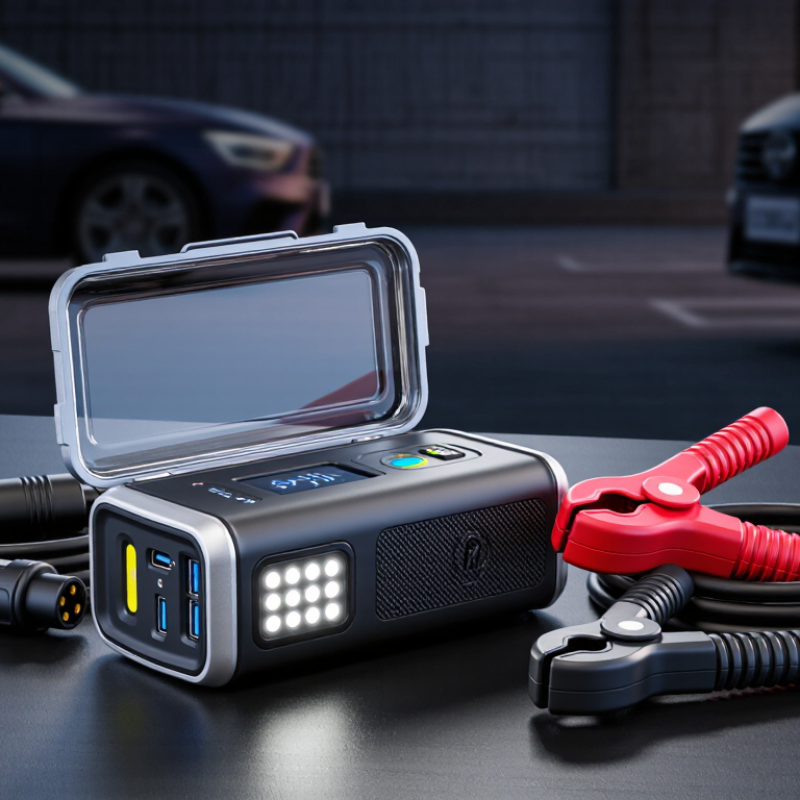
Portable Car Jump Starter Basics: 12V Systems, Battery Types, and Safety Standards
A portable car jump starter is usually designed for a 12V starting system, common in cars, vans, and light trucks. A 12V lead-acid battery may show about 12.6V when fully charged, but voltage drops sharply during a failed start. Check the vehicle manual before connecting anything. Some newer vehicles use sensitive electronics, and a jump starter is not a universal power source.
Battery chemistry affects weight, cold performance, and storage life. Lithium-ion packs are compact and widely used. LiFePO4 packs usually offer stronger thermal stability and longer cycle life, but they can be heavier. Capacity matters, yet advertised peak current can be misleading. A reliable comparison should include continuous current, watt-hours, cable quality, and operating temperature. Small details matter. Thin clamps can heat quickly.
During practical checks, I look for reverse-polarity protection, short-circuit protection, overcharge control, and temperature monitoring. A clear status display helps prevent rushed connections in darkness or rain. Certification claims also need careful reading. UN 38.3 relates to lithium battery transport testing, while IEC 62133-2 addresses certain rechargeable cells and batteries. Regional marks, such as CE or UKCA, do not automatically prove every performance claim. Requirements differ across markets. Verify test reports, model numbers, and rated specifications with the seller. I once trusted a peak-current figure too quickly; the unit worked, but its cables felt warmer than expected. That mistake changed how I assess real-world safety.
2026 Top Portable Car Jump Starter for Global Buyers
Portable Car Jump Starter Basics: 12V Systems, Battery Types, and Safety Standards
Most passenger vehicles use a 12V electrical system. The chart shows common reference points: 12.0V as the nominal system rating, approximately 12.6V for a fully charged lead-acid battery at rest, and approximately 14.2V during typical vehicle charging. Actual readings vary with battery chemistry, temperature, state of charge, vehicle design, and charging control strategy. Select a jump starter with verified reverse-polarity, short-circuit, over-temperature, and over-charge protection.
Reference values are practical automotive electrical benchmarks, not universal operating limits.
Key Performance Metrics: CCA, Peak Amps, Capacity, and SAE J2580 Testing
A reliable portable jump starter should be judged by measured performance, not impressive packaging numbers. Cold Cranking Amps (CCA) reflect current delivered at -18°C for 30 seconds under SAE battery testing conditions. Peak amps usually describe a brief surge. They can look powerful while offering little evidence about sustained cranking. SAE J2580 procedures provide a useful reference for evaluating starting performance, but they do not make every portable unit directly comparable.
Capacity matters during repeated starting attempts. A 12-volt, 20Ah pack has 240Wh nominal energy, yet conversion losses reduce usable output. Battery Council International reports that conventional vehicle batteries commonly last three to five years. Their condition strongly affects jump-start demand. AAA winter testing indicates that battery strength can fall by about 60% near 0°F (-18°C). That detail matters for buyers in Canada, Northern Europe, and high-altitude regions. I have learned not to trust peak-amp claims alone. They are convenient, but sometimes incomplete.
Tips: Request CCA test conditions, discharge duration, temperature, and cable resistance. Check whether testing follows SAE J2580-related methods or only an internal laboratory protocol. Compare usable Wh, not only advertised capacity. Select a unit with verified protection against reverse connection, overcurrent, and overheating. A small screen showing voltage is helpful, though it does not replace a real load test. Some published figures remain difficult to reproduce, so suppliers should provide test dates, instruments, and independent laboratory records.
Battery Technology Comparison: Lithium-Ion Cells, Energy Density, and Cycle Life
For global buyers, a portable car jump starter should balance starting power, weight, safety, and battery endurance. Lithium-ion cells remain popular because they store substantial energy in a compact case. A 10,000 mAh label, however, does not guarantee strong engine-cranking performance. Usable output depends on cell voltage, internal resistance, cable quality, and the battery management system.
Energy density matters during travel. Higher-density cells can reduce pack weight, leaving more space for clamps and protective housing. Conventional lithium-ion chemistry often offers excellent power for its size. Lithium iron phosphate cells usually provide lower energy density, but they can deliver better thermal stability and longer cycle life. Not every vehicle needs the lightest pack. A heavier unit may survive rough storage better.
Cycle life is often misunderstood. Repeated deep discharges, heat inside a parked vehicle, and long storage at full charge can shorten service life. In practical checks, a unit may start several vehicles in one day, yet still lose capacity after months of neglect. Cold weather also reduces available power, even when the cells are healthy. Look for clear ratings, over-current protection, reverse-polarity protection, and cables with firm clamps. Recharge the pack every three to six months. I would not trust impressive peak-current figures alone; manufacturers measure them under different conditions, and real engines can be far less forgiving.
Global Buying Criteria: USB-C PD, IP65 Protection, CE, FCC, and UN38.3
For global buyers, a portable car jump starter should be judged beyond peak current claims. USB-C Power Delivery (PD) matters because it can recharge the unit quickly with compatible chargers. It can also power a phone, tablet, or work light during roadside delays. Check the actual input wattage, cable quality, and supported voltage range. A USB-C socket alone does not guarantee fast charging. Small detail, big difference.
IP65 protection indicates dust protection and resistance to low-pressure water jets. It does not mean waterproof immersion. Keep the starter away from puddles, heavy rain, and damaged ports. In a vehicle, rubber covers should close firmly after every use. I would inspect the clamps, cable flexibility, and display in cold conditions. Product pages often show ideal tests, not awkward roadside handling. That gap deserves attention.
For international purchasing, CE and FCC information can support regional conformity and electromagnetic compliance checks. They should be backed by traceable declarations and laboratory documentation, not printed logos alone. UN38.3 confirms that the lithium battery completed required transport tests. It does not replace safe design, clear instructions, or proper packaging. Ask for test reports, model consistency, and recent production details. I would also verify rated capacity, reverse-polarity protection, and temperature limits. Specifications can be confusing, and some labels are optimistic. Compare evidence with the vehicle, climate, and shipping route. No single certificate answers every question.
Selection Guide by Vehicle: Engine Size, Temperature Range, and Starting Current
Choosing the right portable car jump starter in 2026 starts with engine size, not advertising claims. A small petrol engine usually needs less starting current than a large diesel engine. For engines up to 2.0 liters, a unit rated around 600–1,000 peak amps may be practical. Larger petrol engines often need 1,000–1,500 amps. Diesel engines generally demand more, especially above 2.5 liters.
Temperature range matters in real roadside conditions. Cold weather reduces battery performance and makes engine oil thicker. For winter travel, choose a starter tested below -20°C, rather than trusting a broad label. In hot regions, check whether it can operate above 45°C without overheating. Storage temperature also matters. A device left inside a parked car may face harsher conditions than expected.
Starting current should not be confused with peak current. Starting current better reflects the power available during engine cranking. Read both figures carefully. I once selected a compact unit for convenience and underestimated a larger diesel engine. It worked slowly, but the experience was not reassuring. Leave a margin of at least 20% above the vehicle’s stated requirement. Check battery voltage, clamp quality, cable length, and reverse-polarity protection. A bright work light helps at night. It is a small detail. Recharge the starter every few months, because an unused device can quietly lose power.
2026 Top Portable Car Jump Starter for Global Buyers - Selection Guide by Vehicle: Engine Size, Temperature Range, and Starting Current
| Vehicle and Engine Type | Typical Engine Size | Recommended Peak Current | Recommended Cranking Current | Suggested Operating Temperature | Cold-Weather Recommendation | Suitable Battery System | Selection Notes |
|---|---|---|---|---|---|---|---|
| Small Petrol Cars | Up to 1.5 L | 400–600 A | 150–250 A | −20°C to 60°C (−4°F to 140°F) | Choose at least 600 A peak below −10°C (14°F). | 12 V lead-acid or AGM battery | Suitable for compact hatchbacks, city cars, and small sedans in normal battery condition. |
| Compact and Mid-Size Petrol Cars | 1.6–2.5 L | 600–1,000 A | 250–400 A | −20°C to 60°C (−4°F to 140°F) | Use 800–1,000 A peak for frequent winter use. | 12 V lead-acid, AGM, or EFB battery | A practical range for most family sedans, compact SUVs, and light crossover vehicles. |
| Large Petrol Cars and SUVs | 2.6–4.0 L | 1,000–1,500 A | 400–600 A | −20°C to 60°C (−4°F to 140°F) | Prefer 1,200 A or more peak current below −15°C (5°F). | 12 V lead-acid or AGM battery | Provides additional reserve for larger starter motors, high electrical loads, and partially discharged batteries. |
| High-Displacement Petrol Cars and SUVs | 4.1–6.0 L | 1,500–2,000 A | 600–800 A | −20°C to 60°C (−4°F to 140°F) | Choose a heavy-duty model rated for at least −20°C (−4°F). | 12 V lead-acid or AGM battery | Check cable length and clamp capacity because larger engines may require longer cranking time. |
| Small Diesel Cars | Up to 2.0 L | 800–1,200 A | 350–500 A | −20°C to 60°C (−4°F to 140°F) | Use a unit with a low-temperature rating of −20°C or lower. | 12 V lead-acid, AGM, or EFB battery | Diesel engines generally need more starting power because of higher compression and glow-plug loads. |
| Mid-Size Diesel Cars and SUVs | 2.1–3.0 L | 1,200–1,800 A | 500–700 A | −20°C to 60°C (−4°F to 140°F) | For regular use below −15°C (5°F), select at least 1,500 A peak. | 12 V lead-acid or AGM battery | Allow extra reserve when the vehicle uses multiple glow plugs or has a high-capacity battery. |
| Large Diesel SUVs and Pickup Trucks | 3.1–6.0 L | 1,500–2,500 A | 650–1,000 A | −20°C to 60°C (−4°F to 140°F) | For severe winter climates, select a model rated to −30°C (−22°F) where available. | 12 V lead-acid or AGM battery | Confirm that the product supports the vehicle's battery capacity and diesel engine size. |
| Commercial Vans and Light Trucks | 2.0–6.0 L | 1,500–2,500 A | 650–1,000 A | −20°C to 60°C (−4°F to 140°F) | Choose a high-capacity unit with thick cables and insulated clamps. | 12 V system; verify before connection | Frequent commercial use benefits from a larger internal battery, thermal protection, and repeated-start capability. |
| Vehicles with Dual 12 V Batteries | Various engine sizes | 2,000 A or higher | 800–1,000 A or higher | Follow the product's stated operating range | Use only after confirming the vehicle's battery arrangement and connection procedure. | May use two 12 V batteries; do not assume 24 V compatibility | A standard 12 V jump starter must not be connected to a 24 V system unless specifically designed for it. |
| Hybrid and Plug-In Hybrid Vehicles | Petrol engine plus high-voltage drive system | Usually 400–1,000 A for the 12 V battery | Vehicle-specific | Follow the product and vehicle manual | Cold-weather performance depends on the 12 V auxiliary battery and vehicle electronics. | Usually a separate 12 V auxiliary battery | Use the manufacturer's jump-start points and never connect a portable starter to the high-voltage traction battery. |
Skip to content
