| Low-Silica and Silica-Free Solid Surface Materials | Reduced dependence on crystalline silica; non-porous surface; repairable and refinishable; suitable for thermoforming when the formulation allows it. | Most acrylic solid-surface sheets contain mineral filler and polymer resin. Silica content depends on the formulation and must be verified through the product technical data sheet and safety documentation. | Residential kitchens, healthcare counters, hospitality vanities, laboratory support areas, and public interiors. | Buyers increasingly request transparent mineral composition, occupational safety information, consistent color, and documentation for fabrication dust controls. | Request a full composition statement, Safety Data Sheet, technical data sheet, and written confirmation of silica content. Do not infer composition from appearance alone. |
| Large-Format and Seam-Minimized Panels | Fewer visible joints, cleaner visual appearance, lower potential for seam maintenance, and improved suitability for islands and long counters. | Common sheet formats include approximately 3,680 × 760 mm and 3,680 × 930 mm, although dimensions vary by manufacturer and region. Thicknesses commonly include about 6, 9, and 12 mm. | Kitchen islands, reception desks, retail counters, wall cladding, shower panels, and hospitality furniture. | Stable dimensions, flatness, accurate squareness, protective packaging, and reliable container loading are important for international shipments. | Inspect sheet length, width, thickness tolerance, flatness, edge damage, protective film adhesion, and pallet moisture protection before dispatch. |
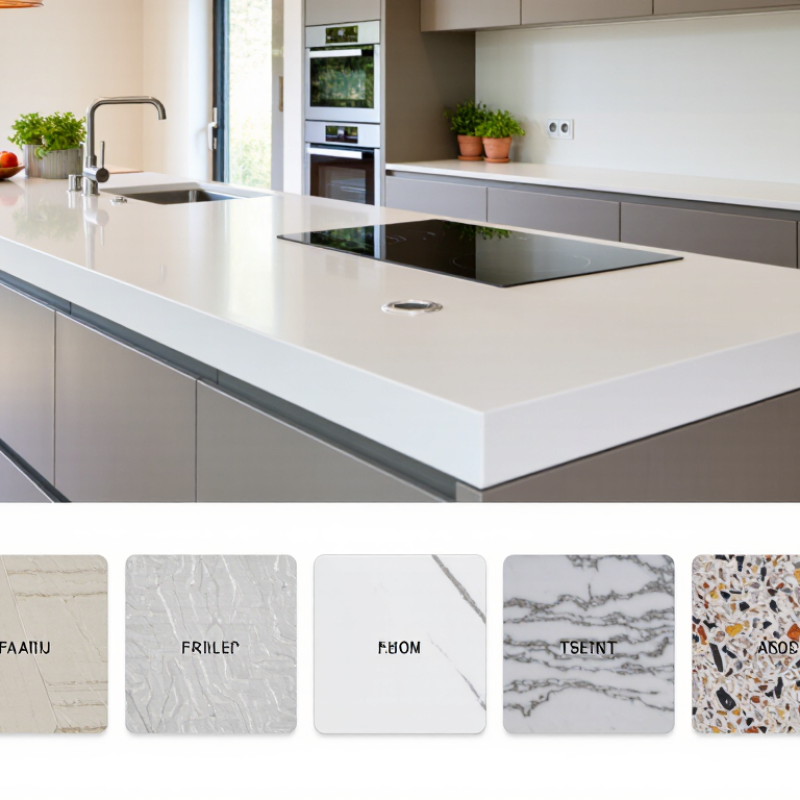
| Natural-Looking Stone and Mineral Patterns | Veined, concrete, terrazzo, limestone, and softly mottled visuals; non-porous performance with a more natural appearance than traditional uniform colors. | Pattern direction and visual movement can vary between batches. Book-matching or directional layouts require sequential sheets from the same production lot. | Premium kitchens, bathroom vanities, hotel interiors, retail displays, office reception areas, and feature walls. | Buyers require approved color samples, lot consistency, pattern maps, high-resolution images, and clear acceptance criteria for shade and veining variation. | Approve a control sample, compare production sheets under standardized lighting, and record acceptable variation limits before mass production. |
| Warm Neutrals and Biophilic Color Palettes | Warm whites, sand, taupe, greige, clay, muted green, and earthy gray tones support hospitality, residential, and wellness-oriented interiors. | Color perception changes with lighting, viewing angle, surface finish, and adjacent materials. Gloss and matte finishes may not appear identical even when the color code is the same. | Residential cabinetry, wellness centers, hotels, restaurants, offices, and healthcare environments. | International buyers typically request physical samples, digital color references, finish samples, and batch-control procedures rather than relying only on screen images. | Use standardized lighting for comparison and retain an approved reference sample from the same production batch whenever possible. |
| Matte, Satin, and Textured Finishes | Lower visual glare, contemporary appearance, and improved ability to disguise light fingerprints or minor surface marks compared with high-gloss finishes. | Surface texture affects cleanability, perceived color, stain resistance, and touch feel. Rougher textures may require more frequent cleaning in high-use areas. | Retail counters, office interiors, hospitality spaces, bathroom furniture, and modern residential kitchens. | Buyers need finish samples, cleaning instructions, scratch-resistance information, and confirmation that the finish is consistent across sheets and fabricated edges. | Check finish uniformity, stain removal performance, cleanability, gloss or texture consistency, and compatibility with recommended maintenance products. |
| Integrated Sinks and Seamless Backsplashes | Visually continuous surfaces, fewer dirt-trapping joints, easier routine cleaning, and coordinated sink-to-countertop design. | Fabricated sink dimensions, bowl depth, drain position, overflow configuration, and installation method must be confirmed before cutting or thermoforming. | Healthcare washrooms, hotel vanities, residential bathrooms, laboratory areas, food-service support spaces, and premium kitchens. | Buyers require accurate shop drawings, drain compatibility, replacement or repair procedures, water-sealing details, and installation tolerances. | Approve dimensional drawings, test water drainage, inspect seam quality, and verify that adhesives and sealants are compatible with the material. |
| Thermoformed Curves and Bespoke Fabrication | Supports curved fronts, coved backsplashes, radiused edges, and sculptural furniture forms; seams can be made visually inconspicuous with proper fabrication. | Forming temperature, heating time, minimum radius, cooling method, and allowable deformation are formulation-specific and must be supplied by the material producer. | Reception desks, hospitality bars, healthcare stations, retail furniture, vanity units, and architectural feature pieces. | Global buyers request fabrication guidelines, CNC compatibility, minimum bend radius, edge-detail drawings, and training or technical support for local fabricators. | Run a fabrication trial using production material. Inspect radius accuracy, surface blistering, discoloration, stress marks, and seam visibility. |
| Repairable and Long-Service Surfaces | Minor scratches, light burns, and localized damage can often be sanded or refinished; solid color throughout the sheet can support repairability. | Repair results depend on color, pattern, finish, damage depth, and technician skill. Highly directional or heavily veined designs may be more difficult to blend. | Schools, hospitals, airports, retail environments, restaurants, offices, and high-use residential spaces. | Buyers value maintenance manuals, repair kits, color-matched adhesive, spare material, warranty terms, and technician guidance. | Conduct stain, heat, scratch, and repair trials using the selected color and finish. Keep spare sheets from the original production lot. |
| Hygienic and Easy-Clean Surfaces | Low liquid absorption and non-porous surfaces help limit the accumulation of dirt when seams, joints, and installation details are properly fabricated and maintained. | Hygiene performance depends on the complete installed system, including seams, sealants, sink connections, cleaning procedures, and surface condition. | Healthcare counters, laboratories, food-service areas, public washrooms, schools, and hospitality facilities. | Buyers often require cleanability evidence, chemical-resistance data, infection-control specifications, and documented maintenance procedures. | Review applicable test reports and cleaning-chemical compatibility. Avoid making antimicrobial claims unless supported by independent test evidence. |
| Improved Chemical and Stain Resistance | Designed to resist common household and commercial contaminants better than many porous alternatives, while still requiring prompt removal of aggressive chemicals. | Resistance varies by formulation, exposure time, concentration, temperature, and finish. Strong solvents, concentrated acids, and harsh alkalis may damage the surface. | Kitchen worktops, laboratory support counters, salons, restaurants, healthcare environments, and commercial washrooms. | Buyers require a chemical-resistance chart covering disinfectants, alcohol-based products, cleaners, oils, food stains, and cosmetics relevant to the project. | Test the exact finish and color with the intended chemicals. Record exposure time, cleaning method, visual change, gloss change, and surface damage. |
| Recycled Content and Lower-Impact Manufacturing | Potentially reduced use of virgin raw materials, improved resource efficiency, and stronger alignment with environmental procurement policies. | Recycled content may be pre-consumer or post-consumer and can vary by product line. Environmental performance should be assessed using verified product-specific data. | Green-building projects, public procurement, offices, hospitality developments, retail interiors, and residential renovations. | Buyers increasingly request recycled-content percentages, environmental product declarations, life-cycle information, factory energy data, and responsible waste handling. | Verify claims through third-party documentation where available. Check whether certificates apply to the exact color, thickness, and production site. |
| Low-VOC Adhesives and Indoor-Air Requirements | Supports indoor-air-quality objectives when the sheet, adhesive, sealant, backing, and installation process are selected as a complete system. | Volatile organic compound performance is product-specific. Adhesives and sealants can materially affect the emissions profile of the completed installation. | Schools, hospitals, offices, residences, hotels, libraries, and other enclosed interior spaces. | Buyers may request VOC emissions reports, indoor-air certifications, safety data, installation instructions, and documentation for all associated products. | Confirm the test method, validity period, product scope, and whether the certification covers the sheet only or the full installed assembly. |
| Fire- and Smoke-Performance Documentation | May be suitable for interior applications requiring documented reaction-to-fire performance, subject to thickness, color, backing, adhesive, and assembly conditions. | Fire classification is not universal for every solid-surface sheet. Results must be linked to the exact product construction and applicable regional standard. | Transit interiors, healthcare projects, hotels, public buildings, offices, airports, and commercial fit-outs. | Buyers require valid fire-test reports, classification documents, thickness details, installation limitations, and compliance with local building regulations. | Review reports from recognized laboratories and confirm that the tested construction matches the proposed sheet, substrate, adhesive, and installation method. |
| Outdoor and UV-Exposure Applications | Some specially formulated solid-surface products can be used in protected or exterior applications, offering design continuity between indoor and outdoor spaces. | UV stability, thermal movement, moisture exposure, and freeze-thaw performance are product-specific. Standard interior sheets should not automatically be specified outdoors. | Covered outdoor kitchens, exterior bar counters, sheltered terraces, marine interiors, and semi-exposed hospitality areas. | Buyers need explicit exterior-use approval, UV-aging data, temperature limits, installation details, warranty conditions, and maintenance requirements. | Verify accelerated-weathering evidence and inspect color change, surface chalking, dimensional movement, and joint performance under the intended exposure conditions. |
| Digital Fabrication and Project Customization | Compatible with CNC routing, waterjet cutting, templated fabrication, recessed details, logos, drainage grooves, and repeatable modular components. | Fabrication parameters depend on sheet thickness, tooling, feed rate, cooling, edge detail, and design geometry. Digital files must include realistic tolerances. | Modular kitchens, healthcare furniture, retail displays, hospitality projects, washroom systems, and complex architectural interiors. | Buyers request CAD files, nesting support, fabrication tolerances, edge profiles, packaging by project zone, and replacement-part traceability. | Approve shop drawings and conduct a first-article inspection before full production. Check cutout accuracy, edge quality, and assembly fit. |
| International Logistics and Packaging Reliability | Improved protection against corner damage, surface abrasion, moisture, and movement during road, sea, rail, and multimodal transport. | Packaging should be designed for sheet weight, crate dimensions, center of gravity, stacking limitations, and local handling equipment. | Global residential developments, hotel projects, retail rollouts, prefabricated interiors, and distributor stock programs. | Buyers prioritize export-grade crates, moisture barriers, corner protection, pallet markings, container loading plans, insurance documentation, and traceable lot numbers. | Inspect crate strength, sheet restraints, protective film, impact indicators where appropriate, packing lists, photographs before sealing, and container condition. |
| Standardized Documentation and Traceability | Supports consistent procurement, installation, maintenance, warranty management, and regulatory review across multiple countries. | Core documents commonly include technical data sheets, installation manuals, care guides, safety data sheets, test reports, warranty terms, and packing records. | Multi-site commercial projects, international distribution, public procurement, healthcare construction, and large residential developments. | Buyers expect document versions in English and, where required, local languages, together with batch numbers, production dates, inspection records, and change-control notices. | Confirm that documents identify the exact product, color, finish, thickness, production site, test standard, issue date, and applicable limitations. |