Best LED Emergency Lights Manufacturer in China
Selecting the Best LED Emergency Lights Manufacturer in China takes more than comparing prices or product photos. Emergency lighting must work when normal power fails. A corridor, stairwell, or warehouse exit leaves little room for guesswork. Buyers should examine illumination performance, battery capacity, charging behavior, housing materials, and installation requirements. Details matter. Led Em Lights should be assessed against the actual site, not just a catalog description. A compact wall-mounted unit may suit a hotel hallway, while a larger industrial space could need different coverage and mounting options.
A dependable manufacturer should provide clear specifications, sample access, and consistent answers about production and quality checks. Ask for test records, battery information, warranty terms, and documentation relevant to the target market. If possible, inspect a sample through a full charge-and-discharge cycle and check how clearly its indicators and instructions can be understood. Small practical checks can reveal problems that polished product images hide. Factory visits or independent inspections may also help confirm that production matches the stated process. Still, no checklist removes every risk. Supplier claims need verification, and samples may not represent every production batch. This deserves honest attention. Comparing several manufacturers on performance, communication, customization, and after-sales support can create a more balanced decision. The best partner is not always the one with the lowest quotation; reliability is built through evidence, careful testing, and clear expectations.
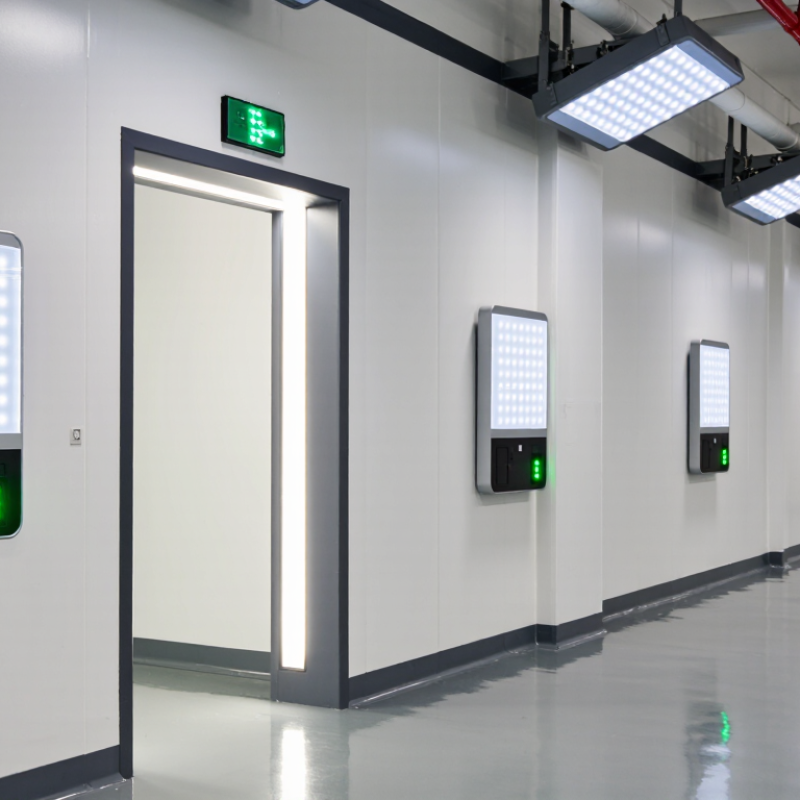
Overview of the LED Emergency Lighting Industry in China
China’s LED emergency lighting industry is shaped by dense urban development, public-safety needs, and a large electronics supply chain. The National Bureau of Statistics reported an urbanization rate of 66.16% in its 2023 Statistical Communiqué. This is useful context, not a direct measure of emergency-light sales. Demand comes from places such as apartment stairwells, metro corridors, factories, and hospitals, where backup lighting must remain dependable during a power cut.
Manufacturers commonly integrate LED modules, batteries, charging circuits, and control systems. Product design must balance runtime, brightness, battery life, and ease of inspection. China’s GB 17945-2024 standard for fire emergency lighting and evacuation indication systems took effect on May 1, 2025, setting an important technical reference for the sector. Buyers should check test documentation and confirm that products suit the installation environment. Small details matter. Battery performance can vary with heat, charging habits, and age. One weak point in market comparisons is that broad lighting-industry figures rarely isolate emergency products, so precise market-size claims deserve caution.
China Fire Emergency Lighting: Minimum Illuminance Requirements
Minimum floor-level illuminance specified for selected evacuation areas in China.
GB 51309-2018 specifies minimum floor-level illuminance of 1 lx for evacuation corridors, 3 lx for densely populated areas and refuge floors, and 5 lx for stairways, lobbies, and refuge passageways. These are regulatory design thresholds, not market-survey measurements.
How to Evaluate LED Emergency Light Manufacturers
Best LED Emergency Lights Manufacturer in China
How to Evaluate LED Emergency Light Manufacturers
Evaluating an LED emergency-light manufacturer requires evidence, not polished product photos. The U.S. Department of Energy’s 2020 U.S. Lighting Market Characterization estimated that LEDs represented about 48% of installed U.S. lighting. That broad market shift makes dependable backup performance especially important. It does not, however, identify the best emergency-light supplier.
Request model-specific test reports and check that they cover emergency operation, not only normal illumination. UL 924 and IEC 60598-2-22 provide relevant safety and performance frameworks. Review documented test results for battery duration, light output, charging behavior, and operation at stated temperatures. Confirm the report matches the exact model and configuration you plan to purchase. Small differences matter.
Ask how the manufacturer controls battery and LED component changes between production batches. Then inspect a sample: simulate a power outage and record startup, illumination, and runtime. A tidy datasheet is not proof. One good sample is not proof either. The DOE figure covers lighting broadly, not emergency fixtures, so it cannot rank manufacturers. That limitation is worth keeping in mind.
Manufacturing Capabilities and Quality Standards
Best LED Emergency Lights Manufacturer in China
Manufacturing quality starts with repeatable processes, not a bright sample unit. A capable Chinese factory should control LED bins, driver components, battery cells, and assembly records by production lot. Technicians can verify illumination with calibrated photometric equipment and test battery discharge at the stated operating temperature. Small details matter. A loose connector can shorten backup time.
The U.S. Department of Energy’s 2022 Solid-State Lighting R&D Opportunities report notes that laboratory LED packages have exceeded 200 lumens per watt. That figure describes packages, not complete emergency luminaires; drivers, optics, and heat affect finished-product performance. Buyers should request test reports for the assembled fixture, including output, charging behavior, and runtime. The distinction is easy to miss.
For safety and consistency, manufacturers can design and test products against IEC 60598-2-22 for emergency luminaires, alongside applicable general luminaire requirements in IEC 60598-1. A disciplined quality system also tracks incoming inspection, aging tests, battery-cycle checks, and corrective actions. Ask for traceable records, not just a certificate image. Even strong processes have limits: battery capacity can drift with age and temperature, so published runtime needs realistic test conditions.
Notable LED Emergency Light Manufacturers in China
Best LED Emergency Lights Manufacturer in China
China’s LED emergency-light sector includes manufacturers serving commercial buildings, factories, hotels, and public facilities. Notable suppliers often differ in battery options, housing design, testing practices, and production scale. Some offer compact wall-mounted units; others make weather-resistant fittings for demanding environments. Product details matter: check rated output, stated backup duration, charging time, and whether the unit supports automatic testing. Details matter. Ask for test reports and clear product specifications, not only catalogue claims.
A capable manufacturer should explain how it checks battery performance, light output, and operation during a power interruption. During evaluation, compare sample units and inspect practical details such as terminal labels, mounting points, and indicator visibility. Ask whether replacement batteries and technical documents remain available after purchase. These questions help buyers assess both product quality and ongoing support. One caveat: a polished sample does not prove every production batch will perform identically. Request recent inspection records and agree on measurable acceptance criteria before ordering. Clear communication is useful, but it cannot replace hands-on checks of the actual model and its operating conditions.
Applications and Considerations for Choosing a Manufacturer
Emergency lighting serves different tasks: guiding people through a hotel corridor, marking a factory exit, or illuminating a stairwell during a power failure. Map each application before contacting a manufacturer. Note mounting height, dust or moisture exposure, ambient temperature, viewing distance, and required backup duration.
NFPA’s Fire Loss in the United States During 2023 estimated 1.39 million fires nationwide.
That scale makes dependable egress planning more than a catalog choice. Small details matter.
Ask manufacturers for photometric files, battery discharge results, thermal test records, and traceable production checks. Confirm that product certifications match the destination market and the project’s specifications; a certificate alone does not prove suitability for every site. The U.S. Department of Energy reports that LEDs use at least 75% less energy than incandescent lighting and can last up to 25 times longer.
Those figures support LED selection, but say little about emergency battery performance. A bright product photo proves little, too. Compare beam coverage and inspect sample units under realistic mounting conditions. Even then, a single site trial may miss future maintenance problems.