FAQS
China Best Portable Heaters for Wholesale Buyers?
China’s portable heaters market attracts wholesale buyers seeking compact warmth, competitive pricing, and scalable supply. Yet product selection should begin with evidence, not attractive catalog photos. The International Energy Agency reports that space heating remains one of the largest energy demands in buildings. This makes efficiency, controls, and safe operation important purchasing factors. For buyers, a 1,500-watt ceramic heater may suit a small office, while a lower-wattage fan heater may better serve bedrooms or temporary workspaces.
The U.S. Department of Energy notes that portable electric heaters can provide localized heating without warming an entire building. That advantage matters for retailers serving apartments, workshops, outdoor shelters, and emergency-use markets. However, wholesale success depends on more than heating output. Buyers should inspect thermostat accuracy, overheat protection, tip-over shutoff, plug specifications, noise levels, packaging strength, and spare-part availability. Check this carefully. Intertek and SGS testing guidance also emphasizes product safety, electrical performance, and destination-market compliance. Requirements may include CE, UKCA, UL, RoHS, or other applicable certifications.
Chinese manufacturers offer broad customization, from white-label casings to smart controls and multilingual manuals. Factory audits, sample testing, and production inspections can reduce costly surprises. Grand View Research and other market analysts continue to identify energy efficiency and compact appliances as important consumer trends, although forecasts differ by methodology. That uncertainty deserves attention. The “best” portable heaters are not always the cheapest or most powerful. They are the units that balance safety, reliability, landed cost, and customer expectations across a buyer’s target market. A small mistake in specification can become a large return rate.
Portable Heater Types: PTC, Ceramic, Infrared, and Oil-Filled Models
China Best Portable Heaters for Wholesale Buyers?
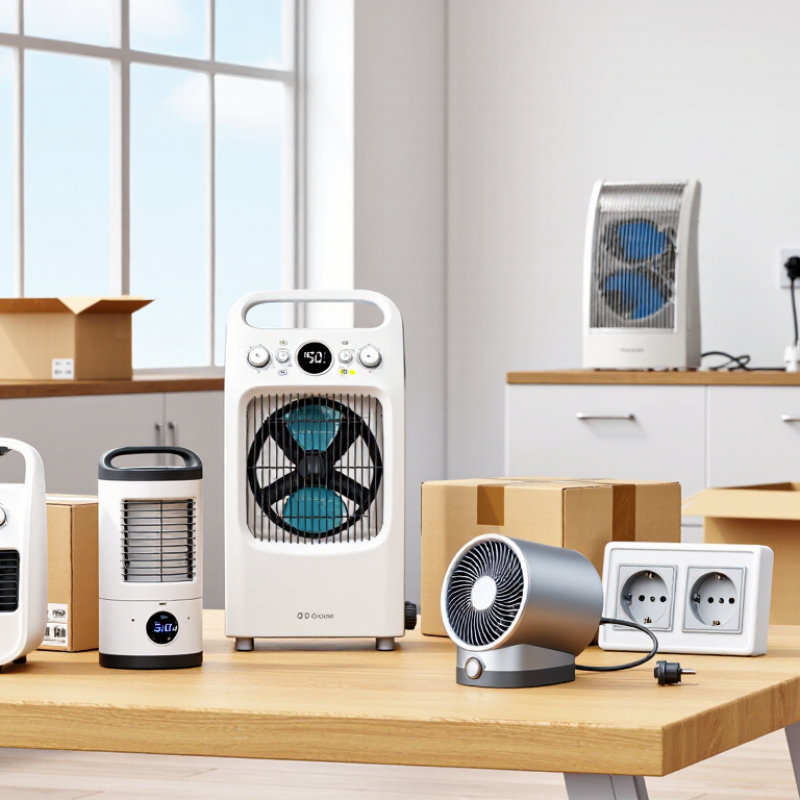
Portable heaters differ greatly in heating speed, comfort, and shipping practicality. PTC heaters warm quickly and regulate temperature efficiently. They suit bedrooms, offices, and small retail spaces. Ceramic models use heated ceramic elements with fans. They spread warmth faster, but fan noise may affect customer satisfaction.
Infrared heaters warm people and nearby surfaces directly. They work well in workshops, balconies, and drafty rooms. However, buyers should explain that infrared heat feels more directional. Oil-filled models heat slowly, then release steady warmth without much noise. Their metal bodies are heavier and need stronger cartons. I have seen attractive prices lose value after damaged-corner claims. Product selection is not only about unit cost.
Tips: Request independent test reports, protection details, plug specifications, and clear user instructions. Check overheat protection and tip-over shutoff during sample testing. Compare heating performance in a real room, not only in a catalog. Ask for carton drop-test results and spare-part availability. Small details matter. Also review the cord length and thermostat accuracy. Some models need better labeling than expected.
For wholesale orders, compare wattage, noise, dimensions, packaging, and target-room usage together. A compact PTC heater may sell well in urban apartments, while an oil-filled model may suit quiet study spaces. Infrared units need careful placement guidance. Ceramic heaters can be attractive, but airflow design deserves closer inspection. Claims should match tested performance. That part is sometimes overlooked.
China Best Portable Heaters for Wholesale Buyers?
Typical Rated Power Ranges by Portable Heater Type
Portable heater power varies by model and market, but these indicative ranges reflect common household units. PTC and ceramic heaters are often selected for compact spaces and fast warm-up, infrared heaters provide directional heat, while oil-filled models generally use higher wattage for steady room heating. Wholesale buyers should also verify voltage, safety certifications, plug standards, controls, and target-market requirements.
Heating Capacity Guide: 1 kW Equals Approximately 3,412 BTU/h
China Best Portable Heaters for Wholesale Buyers?
For wholesale buyers, heating capacity starts with a clear conversion. One kilowatt equals approximately 3,412 BTU/h of heat output. Therefore, a 2 kW portable heater provides about 6,824 BTU/h, while a 3 kW model delivers roughly 10,236 BTU/h. These figures describe electrical heating capacity, not guaranteed room temperature. Measure the room.
A 1 kW unit may suit a small, insulated office or bedroom. A larger, drafty workshop can require considerably more power. Ceiling height, window quality, outdoor temperature, and door opening frequency all affect performance. In practical testing, a heater may cycle often instead of running continuously. Small details matter. Buyers should compare rated output, thermostat control, airflow, noise, and power consumption.
For bulk purchasing, request test reports showing actual wattage and temperature rise. Check whether the heater uses the correct voltage, plug configuration, fuse protection, and stable packaging for transport. A 2 kW heater drawing around 2,000 watts can overload a weak circuit when other equipment shares the outlet. Infrared models may feel warmer on nearby surfaces, while fan heaters distribute heat faster. Neither option fits every space. I have seen buyers select higher BTU ratings, then overlook insulation and operating cost. That decision deserves another review before ordering large quantities.
Wholesale Safety Standards: IEC 60335-2-30, UL 1278, CE, and RoHS
China Best Portable Heaters for Wholesale Buyers?
For wholesale buyers, safety compliance should guide every portable heater purchase. IEC 60335-2-30 covers safety requirements for household and similar electric room heaters. It addresses heating elements, insulation, abnormal operation, and temperature limits. UL 1278 applies to portable electric room heaters in relevant North American markets. Buyers should request current test reports, not only printed compliance claims.
CE marking indicates conformity with applicable European Union requirements. It depends on proper technical documentation and a valid Declaration of Conformity. RoHS controls restricted substances in electrical and electronic products. It does not replace electrical safety testing. During factory checks, examine the rating label, plug type, cable thickness, thermal cutoff, and tip-over protection. Small details matter. A missing warning label can create avoidable problems.
Tips: Ask for reports matching the exact model number. Verify voltage, frequency, and destination-market requirements. Check whether documents come from a competent testing laboratory. Keep samples for incoming inspection and compare them with production units. Do not assume one certificate covers every variation. A different thermostat or plastic housing may require review. Buyers sometimes focus too heavily on price, and that is understandable. Still, a cheaper heater can become expensive after failed inspections, returns, or safety complaints. Compliance is not always perfectly simple, so independent technical review remains worthwhile.
Supplier Evaluation: MOQ, Lead Time, 1,500 W Ratings, and Warranty Terms
China Best Portable Heaters for Wholesale Buyers?
For wholesale buyers, supplier evaluation should begin with measurable terms, not attractive catalog photos. A 1,500 W heater draws about 1.5 kWh per operating hour. Ask suppliers for verified input power, heating output, plug configuration, temperature controls, and test documentation. The U.S. Energy Information Administration reports that space heating used about 42% of residential energy in its 2015 RECS data. Efficiency and control accuracy therefore affect operating costs.
MOQ and lead time need written confirmation. A low MOQ can hide higher unit prices, limited customization, or weaker quality checks. Ask whether the quoted MOQ applies to one model, one color, or a mixed container. For repeat orders, request production schedules showing sample approval, component purchasing, assembly, inspection, and shipment. A practical target may be 15–30 days for standard units, but this varies sharply during peak seasons. I have seen buyers trust optimistic dates too quickly.
Warranty terms deserve equal attention. Require a clear period, defect definition, replacement process, spare-parts policy, and response time. The NFPA reports that heating equipment causes thousands of home fires annually, with portable heaters carrying a disproportionate risk. That makes overheat protection, tip-over shutoff, thermal fuses, and traceable inspection records essential. A two-year warranty sounds strong, but it means little without usable claim procedures. Supplier promises should be tested against pre-shipment samples and independent inspection reports.
China Best Portable Heaters for Wholesale Buyers? - Supplier Evaluation: MOQ, Lead Time, 1,500 W Ratings, and Warranty Terms
| Evaluation Criteria | Supplier Profile A Low-MOQ Specialist |
Supplier Profile B Standard OEM Factory |
Supplier Profile C High-Volume Manufacturer |
Supplier Profile D Retail-Ready Supplier |
Supplier Profile E Custom-Design Factory |
|---|---|---|---|---|---|
| Typical product configuration | Portable ceramic fan heater with adjustable thermostat | Portable ceramic heater with two heat settings and fan-only mode | Portable ceramic heater with digital controls and timer | Compact PTC heater with tip-over and overheat protection | Portable PTC heater with custom housing and control panel |
| Rated heating power | 750 W / 1,500 W | 750 W / 1,500 W | 750 W / 1,500 W | 750 W / 1,500 W | 750 W / 1,500 W |
| Available voltage and frequency | 120 V, 60 Hz; 220–240 V, 50/60 Hz | 120 V, 60 Hz; 220–240 V, 50 Hz | 120 V, 60 Hz; 220–240 V, 50/60 Hz | 120 V, 60 Hz; 220–240 V, 50/60 Hz | Configured according to destination market |
| Minimum order quantity (MOQ) | 100 units per model | 300 units per model | 1,000 units per model | 500 units per model | 1,500 units per custom design |
| Sample order policy | 1–2 samples; sample cost refundable after bulk order | 1 sample; sample and courier costs paid by buyer | 1 sample from production line; approval required before mass production | 1–3 samples available from existing stock | Engineering sample required before tooling and production |
| Standard production lead time | 20–25 calendar days after deposit and artwork approval | 25–35 calendar days after deposit and specification confirmation | 30–40 calendar days after deposit and production scheduling | 20–30 calendar days for stocked configurations | 45–60 calendar days, excluding tooling and certification time |
| Packaging and private-label capability | Custom color box, barcode label, and instruction manual | Custom carton, logo label, manual, and carton markings | Full retail packaging, pallet labels, and container loading plan | Retail-ready packaging with multilingual documentation | Full packaging customization subject to artwork approval |
| Safety features | Overheat protection and tip-over switch | Overheat protection, tip-over switch, and thermal fuse | Overheat protection, tip-over switch, thermal fuse, and child-lock control | Overheat protection and tip-over switch included as standard | Safety configuration depends on the approved design |
| Electrical compliance documentation | Test reports and declaration documents available on request | Documentation package available for the selected voltage market | Factory test records and market-specific compliance documents | Retail documentation, user manual, and product labels included | Compliance testing arranged after final design approval |
| Pre-shipment quality inspection | Basic function test and visual inspection | Function, electrical safety, appearance, and carton inspection | Incoming-material, in-process, final, and random carton inspections | Function test, packaging check, and sample-based inspection | Inspection plan agreed during the pilot-production stage |
| Warranty period | 12 months | 12 months | 24 months | 18 months | 12 months |
| Warranty remedy | Replacement parts or credit for confirmed manufacturing defects | Replacement parts; defective-unit credit subject to inspection | Replacement parts, repair support, or credit based on defect rate | Replacement units or parts for verified defects | Repair parts and technical support under the approved warranty scope |
| Recommended buyer type | Small distributors testing demand or regional wholesalers | Established importers seeking regular OEM production | National distributors and container-volume buyers | Retailers requiring ready-to-sell packaging and documentation | Buyers developing a differentiated private-label product |
| Overall wholesale suitability | Good for low-risk testing | Good for repeat OEM orders | Best for high-volume purchasing | Good for retail distribution | Best for long-term development |
| Buyer verification checklist: confirm the destination-market voltage, applicable electrical safety requirements, product test reports, carton drop-test results, spare-parts policy, warranty exclusions, production schedule, and inspection rights before placing a purchase order. | |||||
The figures shown are practical wholesale benchmark ranges for supplier comparison and should be verified against the final quotation, approved specification, production contract, and destination-market compliance requirements.
China Sourcing Checklist: Factory Audits, IP24 Protection, and Quality Testing
China Best Portable Heaters for Wholesale Buyers?
A reliable sourcing checklist starts with a physical factory audit. Review production capacity, worker training, incoming-material records, and calibration logs. Check whether serial numbers follow each heater from assembly to shipment. A polished showroom can hide weak process control. Ask to inspect a running production line, not only finished samples.
IP24 protection requires careful verification. Under IEC 60529, the first rating protects against solid objects above 12.5 millimeters. The second indicates protection from water splashing from any direction. It is not waterproof. Request documented ingress tests, insulation checks, leakage-current testing, and tip-over protection tests. Test thermal cutoffs after extended operation, not just during a short demonstration. Small details matter.
UNEP’s 2023 Global Status Report states that buildings consume about 30% of global final energy and produce roughly 26% of energy-related emissions. The IEA’s Energy Efficiency 2023 report identifies space heating as a major building energy demand.
Wholesale buyers should therefore compare measured wattage, heating output, standby consumption, and temperature stability. Use an independent laboratory when possible. Factory reports may be accurate, but they still need verification. I have learned that one overlooked loose terminal can undermine an otherwise impressive batch. Controls, labels, packaging, and user instructions deserve the same scrutiny as the heating element.
Related Posts
-
Ultimate Guide to Portable Heaters Top Tips for Efficient Heating
-

10 Best Natural Gas Patio Heaters for Ultimate Outdoor Comfort in 2023
-
The Ultimate Guide to Choosing the Best Patio Heater Propane for Efficient Outdoor Heating
-
How to Choose the Best Garden Heater for Your Outdoor Space?
-

2025 Top 5 Natural Gas Patio Heaters for Perfect Outdoor Comfort
-

Best IR Panel Heater Options for Global Buyers to Consider?
Skip to content