
FAQS
China Top Small Umbrella Manufacturers for Global Buyers?
China Top Small Umbrella Manufacturers for Global Buyers? This question deserves more than a supplier list. A Small Umbrella may look simple, yet its ribs, fabric, coating, and closing mechanism determine real value. This guide examines Chinese manufacturers through practical sourcing standards. It considers product quality, production capacity, customization, communication, and export readiness. The goal is useful comparison, not empty promotion.
Experienced buyers usually request samples before discussing large orders. A sample should open smoothly, close firmly, and fit inside its stated case. Check the shaft for wobbling. Examine stitching around the canopy. Test the handle after repeated use. Factory audits can reveal cleaner production lines, organized material storage, and consistent inspection procedures. Buyers should also verify business registration, testing reports, packaging details, and shipment records. Reliable manufacturers explain tolerances clearly. They do not promise perfection too quickly.
Some suppliers specialize in compact manual umbrellas. Others produce automatic models, inverted designs, children’s styles, or branded promotional items. Material choices matter. Pongee fabric, fiberglass ribs, steel shafts, and rubberized handles create different cost and durability levels. Certifications may vary by destination, so importers must confirm current requirements independently. A polished catalog is not proof of stable quality. Even a promising factory can struggle during peak seasons. That weakness deserves attention. This overview therefore encourages sample testing, written specifications, transparent payment terms, and ongoing quality checks. The best partner is not always the cheapest one. It is the manufacturer that communicates honestly and delivers consistent Small Umbrella products at an agreed standard.
Types of Small Umbrellas Produced by Chinese Manufacturers
Chinese umbrella manufacturers produce several compact formats for global buyers. The common three-fold umbrella balances portability, canopy coverage, and cost. Closed, it often fits a handbag or office drawer. Five-fold models shrink further, but their shorter ribs can reduce wind stability. They suit travel kits, event gifts, and emergency use. Small does not always mean fragile.
Automatic folding umbrellas open with a spring-loaded shaft and one-button control. Manual versions are lighter and usually simpler to repair. Reverse-folding umbrellas keep wet fabric inside after closing, helping protect car seats and entryways. UV-protective parasols use coated polyester or pongee fabric. Buyers should request test evidence instead of trusting printed claims. Children’s compact umbrellas need rounded tips, secure runners, and age-appropriate opening force.
For sourcing, inspect rib joints, shaft alignment, stitching, handle grip, and closure straps. A practical sample test includes repeated opening, water spray, and moderate wind exposure. Factory inspection records can reveal consistency better than catalog photos. Custom options may include canopy printing, pouch design, recycled fabric, and carton specifications. Yet every extra feature can add weight or failure points. That trade-off deserves honest review. A low-cost umbrella may suit a promotional order, but daily users need stronger ribs and dependable mechanisms. Some samples look excellent at first. Then the button sticks. Small details decide repeat orders.
Key Manufacturing Regions and Supplier Specialties in China
China’s small umbrella manufacturing base is highly regional. Zhejiang’s Shangyu district is the best-known production cluster, with factories specializing in compact folding umbrellas, windproof frames, and private-label orders. Nearby suppliers often integrate fabric cutting, shaft forming, printing, assembly, and inspection. Guangdong manufacturers commonly focus on promotional umbrellas, gift packaging, and rapid customization. Fujian and Jiangsu suppliers are also useful for lower-volume orders, travel umbrellas, and mixed product ranges.
UN Comtrade and ITC Trade Map data for HS 6601 show China holding the world’s largest umbrella export position, with annual export value exceeding US$1 billion in recent reporting years. This scale reflects mature component networks, not identical factory quality. Buyers should compare frame materials, rib thickness, canopy coating, opening-cycle tests, and carton drop results. A low quoted price may hide weaker ribs or inconsistent automatic mechanisms.
My sourcing experience suggests requesting production samples from at least three regions. Ask for measurable details, such as a 54-centimeter closed length, 190T polyester fabric, and documented wind testing. These specifications are useful, but they are not universal standards. Supplier certificates also require verification. Some factories are excellent assemblers, while others mainly trade through subcontractors. That distinction can change lead times, inspection control, and after-sales responsibility.
How China’s Small Umbrella Production Process Works
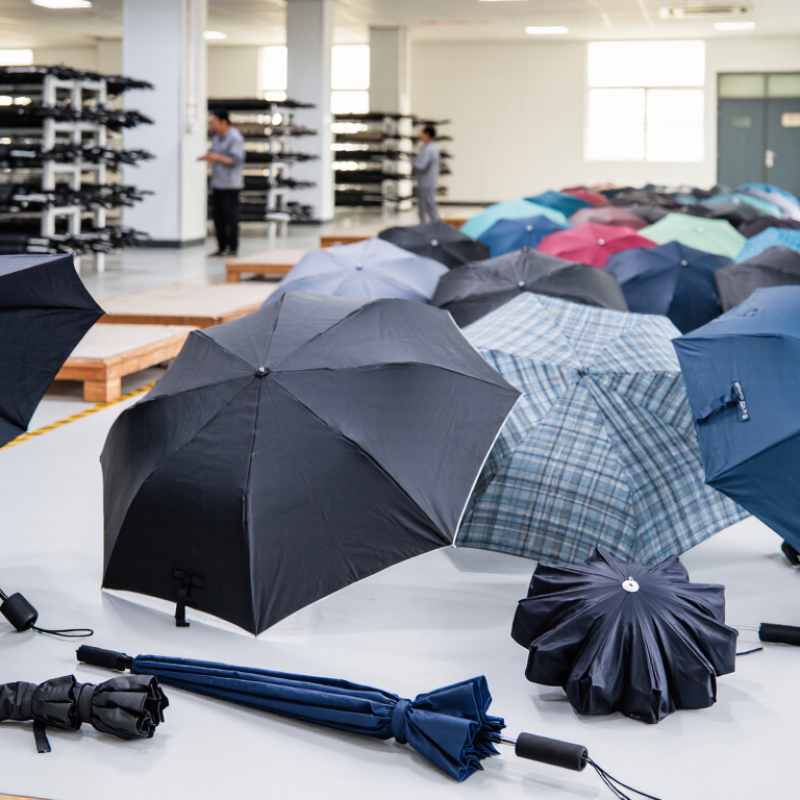
In China’s small umbrella factories, production usually begins with a technical sample, not a sales photo. A buyer confirms canopy diameter, folded length, ribs, shaft material, handle shape, and opening force. The factory then checks polyester or recycled fabric rolls for color, coating, and weaving defects. Patterns are cut by machine, while operators inspect edges manually. This combination improves consistency, although small differences can appear between fabric batches. Clear specifications reduce later disputes.
Panels are printed or dyed before being stitched into a canopy. Workers join each seam with controlled thread tension, then attach the top cap, runner, ribs, and stretchers. The frame comes next. Rivets must hold firmly without blocking smooth movement. Handles are fitted with adhesive or mechanical locks, depending on the design. Experienced quality staff open and close samples repeatedly, check wind resistance, and measure leakage after water spraying. These tests resemble real use more closely than visual inspection alone.
Packing follows only after loose threads, sharp edges, stains, and uneven printed details are removed. Cartons are checked for moisture protection and counted against the purchase order. No factory gets every batch perfect. A rushed inspection can still miss weak rivets or fabric shrinkage, so independent pre-shipment checks are valuable for global buyers. Production records, retained samples, and corrective-action notes also make future orders easier to control. Small details matter.
Quality Standards and Customization Options for Global Buyers
Global buyers increasingly assess small umbrella manufacturers through measurable quality, not attractive samples alone. Grand View Research valued the global umbrella market at approximately USD 7.1 billion in 2023, with steady growth expected through 2030. This expansion raises pressure on Chinese factories to control every component, including ribs, shafts, fabric coatings, and automatic openers.
A dependable manufacturer should operate an ISO 9001-based quality system, with documented inspections and corrective actions. The ISO Survey 2023 recorded more than 1.26 million ISO 9001 certificates worldwide, showing how common structured quality management has become. However, certification is not proof of perfect umbrellas. Buyers should request test records for wind resistance, opening cycles, fabric colorfastness, corrosion, and water repellency. Small details matter.
Customization can include canopy diameter, folded length, handle materials, printing methods, packaging, and recycled polyester fabric. According to Grand View Research, polyester remains widely used because it balances durability, weight, and production cost. I have found that customization often exposes weak communication. A digital sample may look correct, while the stitched edge feels uneven. Buyers should approve a physical pre-production sample, define acceptable defect limits, and use batch inspections based on ISO 2859-1 sampling principles. Some specifications still need revision after field testing. That is normal, not failure.
How to Select and Evaluate a Chinese Small Umbrella Manufacturer
China Top Small Umbrella Manufacturers for Global Buyers?
How to Select and Evaluate a Chinese Small Umbrella Manufacturer
China remains a major sourcing base for compact umbrellas. Grand View Research estimated the global umbrella market at about US$7 billion in 2023, with steady growth expected through 2030. For buyers, factory selection matters more than a low quotation. Request a live production video, material specifications, and recent inspection records. Check canopy fabric, frame strength, handle fitting, and closing force. A compact umbrella should fit a small bag without feeling fragile.
Evaluate production consistency, not only the sample. Ask for folding-cycle test results, water-repellent testing, and carton drop-test records. An ISO 9001 quality system can show process discipline, but it does not guarantee every shipment. Compare pre-production samples with random finished units. I have seen attractive samples fail at the rib joint. That detail is easy to miss. Industry reports from Mordor Intelligence also indicate continued demand for portable and weather-resistant umbrella products, increasing pressure on suppliers to improve durability.
Tips: Use a written specification sheet. Include open diameter, folded length, weight, fabric density, rib material, logo method, packaging, and acceptable defect limits. Request an independent inspection before shipment. Keep payment stages linked to measurable quality checks. Do not choose the cheapest offer too quickly. A lower unit price may hide thinner fabric, weaker springs, or higher replacement costs. One overlooked detail can damage an otherwise reliable sourcing plan.
Skip to content
