
FAQS

How to Choose the Best Advertising Flag Pole

Choosing the right Advertising Flag Pole starts with the place it will stand and the message it must display. A tall pole can make a flag easier to see above parked cars or a busy sidewalk, but it may be awkward in a small courtyard. Measure the available space, check overhead clearance, and consider how people will approach the display. These simple checks can prevent a flag from crowding an entrance or disappearing behind other signs.

The flag’s size and shape should match the pole’s specifications. Review the manufacturer’s guidance for compatible flag dimensions, mounting hardware, and expected wind conditions. A rotating arm can help keep a graphic visible when the wind shifts, while a simple pole may suit sheltered locations. No setup is perfect. Wind changes, and a display that looks balanced on a calm day may behave differently in gusts. Choose a stable base or suitable ground installation, and inspect fittings regularly for looseness, wear, or corrosion.

Material matters, too. Aluminum is often chosen for its lighter weight and resistance to rust, while other materials may offer different durability or appearance. Think about how often the pole will move. A portable base can be convenient for events, but it still needs a level surface and careful placement. Before buying, compare the full system—not just the pole—including the base, flag, and replacement parts. The best choice is the one that fits the site, stays practical to maintain, and presents the message clearly. Sometimes the overlooked detail is the base.
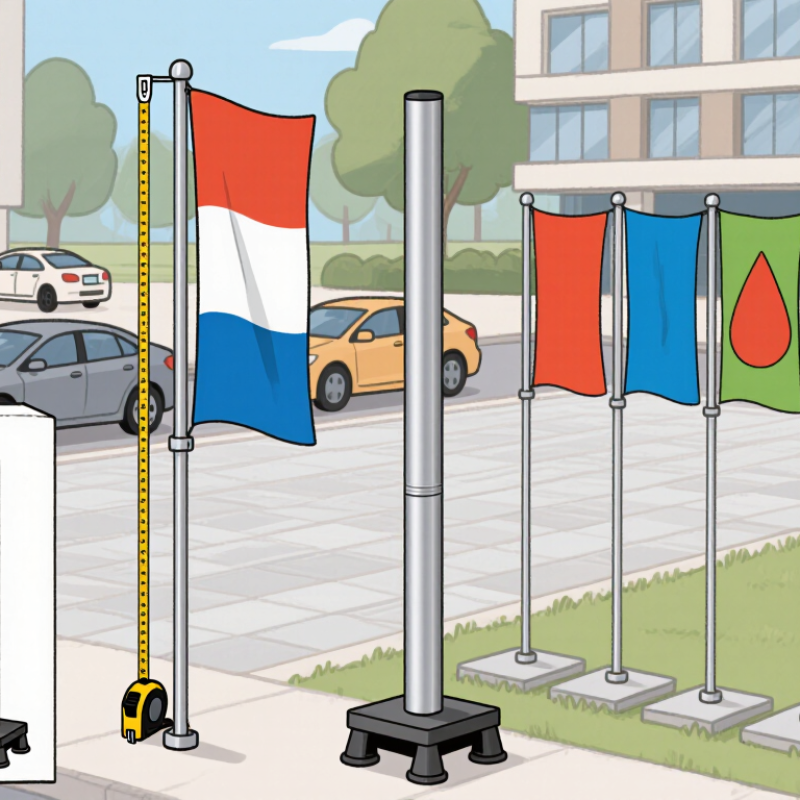
How to Choose the Best Advertising Flag Pole

Understanding Advertising Flag Poles and Their Uses

An Advertising Flag pole supports a lightweight fabric message where people pass at walking or driving speed. Retail entrances use tall feather or teardrop flags to mark promotions; event teams use portable poles to identify registration points. The pole’s shape affects how the fabric hangs and moves. Wind changes everything. A flexible pole can keep a flag visible in a breeze, while an unsuitable base may wobble on pavement. Choose the base for the surface, such as a ground stake for soil or a weighted base for a hard floor.

The Outdoor Advertising Association of America reported that U.S. out-of-home advertising revenue reached $9.1 billion in 2023, up 2.1% from 2022. This broad industry figure shows continued investment in outdoor visibility; it does not measure flag-pole sales specifically. For a flag installation, check the product’s stated fabric dimensions, pole height, base compatibility, and recommended wind limits. Also consider whether the flag is single- or double-sided: a reverse image may be hard to read from one direction. It is easy to focus on height and overlook setup time. That trade-off matters. A flag that is awkward to transport or assemble may stay in storage, even when its message is well designed.

Comparing Pole Types and Mounting Options

How to Choose the Best Advertising Flag Pole
Comparing Pole Types and Mounting Options

The right pole depends on where the flag will stand and how often you move it. Fiberglass poles flex in gusts, which can reduce stress on the flag, while aluminum poles feel rigid and are often suited to steady, repeated use. Telescopic poles pack down for transport, but their locking sections need regular checks. Sectional poles are simple to replace or store, though assembly takes a little longer. No type is perfect.

Mounting matters just as much. A ground spike works well in firm soil, such as a lawn beside a walkway. Use a cross base on flat pavement, and add a suitable weight if the display could catch wind. Wall mounts save ground space, but check the surface and fixings before installation. For soft sand or uneven ground, a standard base may wobble. Test the setup before leaving it unattended, and follow the pole maker’s wind guidance.

Tips: Match pole height to the flag size; too much fabric can strain the joints. Check connectors and base stability before each use. Small details count. I’d also reconsider a lightweight setup for an exposed corner: it may look tidy at first, then lean when conditions change.

Choosing Pole Height, Material, and Flag Compatibility

Choosing an advertising flag pole starts with the space around it, not the catalog photo. Measure from the ground to nearby awnings, branches, and doorways. A pole that looks tall in an open lot may feel awkward beside a shop entrance. For street-level viewing, lift the message above parked cars while keeping the base stable.

Material affects weight, handling, and durability. Aluminum is light and easy to carry; fiberglass can flex in gusts. Check the pole’s wind guidance rather than assuming thicker means safer. Flag compatibility matters just as much. Match the pole to the flag’s sleeve, pocket, or grommets, and check the width and attachment points. A feather flag needs a curved arm or shaped support; a rectangular banner may use a crossbar. Leave room for the fabric to move. If it twists or covers its own text, the setup is assembled but not useful. That detail is easy to miss.

Tips: Compare the assembled height, not just pole length. Confirm the base fits the surface, and test the flag before an event. Unsure about a measurement? Check it again.

How to Choose the Best Advertising Flag Pole

A practical starting point is a flag width around 25–33% of pole height. These approximate ranges are a sizing guide, not a universal standard: flag shapes and sleeve designs vary. Check the flag’s sleeve or pocket dimensions against the pole system, and choose a pole material suited to your conditions and how often it will be moved.

Assessing Site Conditions and Weather Resistance

Assess the site before choosing a flag pole. A rooftop, open car park, and sheltered walkway experience very different wind exposure. NOAA’s 1991–2020 U.S. Climate Normals provide station-level wind data, useful for understanding local patterns. Pair those records with an on-site check; nearby buildings can channel gusts into unexpected corners. Wind changes everything.

The National Weather Service Beaufort scale describes winds of 25–31 mph as moving large branches, and 32–38 mph as moving whole trees. These observations are not pole ratings, but they help identify conditions that deserve attention. ASCE/SEI 7-22 maps basic wind speeds by location and risk category. Ask whether the pole, base, and mounting method have documented capacity for your site’s conditions. A tall pole may look sturdy, yet its base can be the weak point.

Check the ground, too. Soft soil, paving edges, and rooftop parapets affect anchoring and airflow. Look for gust corridors between buildings, salt exposure near the coast, and repeated pooling after rain. A walk-through can miss seasonal changes; I would note that limitation rather than trust one visit. Record the pole height, nearby obstacles, surface type, and local gust history before comparing options.

How to Choose the Best Advertising Flag Pole - Assessing Site Conditions and Weather Resistance

Assessment factor What to check on site Suitable option or action Weather and safety considerations
Ground surface Identify whether the pole will stand on soil, lawn, asphalt, concrete, paving, or indoors. Use a ground spike only where the soil can accept it securely. For hard, level surfaces, select a compatible weighted base or an approved permanent fixing. Do not assume a base intended for one surface will remain stable on another. Check the base instructions and inspect it after installation.
Wind exposure Note open fields, coastal areas, hilltops, street corridors, and gaps between buildings, where wind may be stronger or more turbulent. For exposed locations, choose a system specifically rated for the conditions by its manufacturer, and plan to lower or remove the flag when required. Flags catch wind and place load on the pole and base. There is no single safe wind-speed limit for every pole, flag, base, and installation; follow the product’s stated limits.
Flag shape and area Check the flag’s dimensions and shape, such as feather, teardrop, or rectangular, as well as how freely it can move. Match the pole and base to the flag size specified by the supplier. Avoid fitting an oversized flag to a pole system not designed for it. Larger flag areas generally catch more wind. Ensure the flag cannot strike pedestrians, vehicles, glazing, or overhead obstructions.
Pole material Consider expected use, transport frequency, exposure to moisture, and the need for a flexible or rigid pole. Fiberglass poles are commonly used where flexibility is useful; aluminum poles are lightweight and corrosion-resistant when properly finished. Confirm the material and intended use with the supplier. No material makes a pole immune to damage. Check for cracks, bends, loose joints, corrosion, and wear before each use.
Base and anchoring Check available space, surface level, pedestrian traffic, and whether the location permits drilling or permanent anchoring. Choose a base designed for the pole and surface. Use only the specified ballast or anchoring method, and keep the base positioned as instructed. A base that shifts, rocks, or lifts is not secure. Do not improvise ballast or place a base where it creates a trip hazard.
Rain, humidity, and salt air Assess frequent rain, persistent humidity, sprinkler exposure, and proximity to the coast. Select outdoor-suitable materials and finishes, and check that fittings and connectors are intended for repeated outdoor use. Rinse off salt and dirt where appropriate, dry stored components, and replace corroded or damaged hardware.
Clearance and surroundings Measure overhead clearance and check for power lines, branches, signs, building edges, and nearby pedestrian routes. Choose a pole height and placement that keep the flag clear of obstacles throughout its movement. Relocate the display if safe clearance cannot be maintained. Never install or raise a pole near overhead power lines. Allow extra room for the flag to move in changing wind.
Inspection and operating plan Determine who will inspect, raise, lower, and store the display, including during closures or severe weather. Set a routine to check connections, base stability, pole condition, and fabric wear. Keep the manufacturer’s installation and removal instructions available. Lower or remove the flag before conditions exceed the system’s stated operating limits, and after storms inspect the entire assembly before reuse.

Note: Site conditions, flag dimensions, pole design, and base type all affect stability. Use the manufacturer’s installation guidance and weather limits for the exact system selected; this table is a general selection guide, not an engineering rating.

Evaluating Durability, Portability, and Maintenance Needs

A reliable advertising flag pole must handle repeated setup, gusts, and damp storage—not just look sturdy in a product photo. Check the pole material, joint fit, base weight, and fabric attachment points. The National Weather Service’s Beaufort wind scale describes 19–24 mph winds as strong enough to sway small trees. That is a useful reminder: a flag catches wind like a small sail, so a tall, light pole may flex more than expected. Ask for site-specific wind guidance, not a vague “all-weather” claim.

Portability depends on packed length, total weight, and how quickly sections lock together. A pole that fits in a car but takes ten minutes to assemble may be less practical than a slightly heavier one-piece option.

For fabric, ASTM D5034 measures breaking strength and elongation; request test results for the actual fabric, since construction affects wear.

Maintenance is simple, but easy to neglect: rinse off grit, dry the fabric before storage, and inspect seams, connectors, and ground spikes for fraying, cracks, or rust. I would not assume a stated lifespan applies everywhere. Coastal salt, frequent transport, and long sun exposure can shorten service life, while routine checks can catch small failures early.