FAQS

How to Choose the Best Outdoor Wall Heater?

Choosing an outdoor wall heater is not simply about selecting the highest heat rating. The right model must suit your wall, seating layout, weather exposure, and available power. A small balcony needs different coverage than a deep patio with an outdoor kitchen. Measure the area carefully. Then observe where people actually sit, because heat rarely reaches every corner equally.

John Barba, a longtime hearth-industry educator, puts the decision clearly: “The best heater is the one that matches the space, fuel, and way people actually use it.” That principle matters when comparing infrared and gas systems. Infrared heat can warm people directly, much like sunlight on your shoulders. Gas models may cover larger open areas, but they require safe ventilation and responsible installation. Check the manufacturer’s clearances, mounting height, weather rating, controls, and maintenance instructions before buying.

Small details often decide comfort. A tilted wall bracket can aim warmth toward a dining table instead of an empty walkway. A timer can prevent unnecessary energy use after guests leave. Wind can weaken perceived warmth, even when the heater appears powerful. No choice is perfect. I once assumed a stronger unit would solve everything, but poor placement created hot and cold zones. That mistake is worth remembering. This guide will examine heating performance, installation practicalities, operating costs, safety features, and long-term durability. The goal is not the most impressive specification sheet. It is dependable warmth where people sit, season after season.
How to Choose the Best Outdoor Wall Heater?

Define Heating Coverage: 1,500–2,000 Watts for Typical Outdoor Zones

How to Choose the Best Outdoor Wall Heater?

Define Heating Coverage: 1,500–2,000 Watts for Typical Outdoor Zones

A 1,500–2,000-watt wall heater suits many small patios, balconies, and covered seating areas. The U.S. Department of Energy converts one kilowatt-hour into 3,412 Btu. Therefore, 1,500 watts produces about 5,118 Btu per hour, while 2,000 watts produces roughly 6,824 Btu. In practical use, this output often supports approximately 6–12 square meters. Coverage changes with wind, ceiling height, wall insulation, and heater mounting position. It is not a perfect promise.

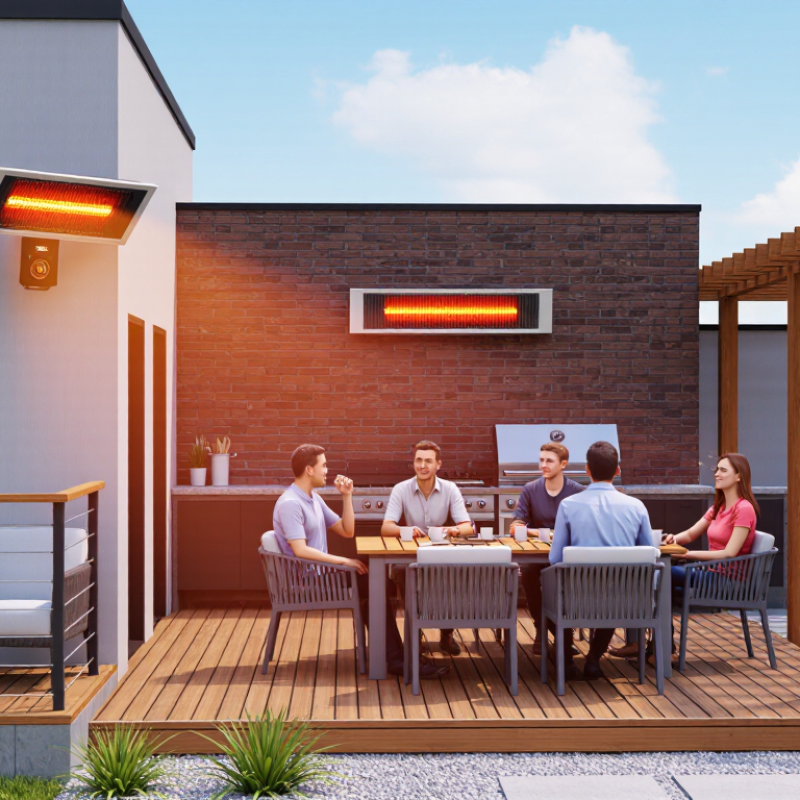
Infrared heating warms people and nearby surfaces more directly than open air. ASHRAE Handbook—Fundamentals explains that radiant temperature and air movement strongly affect thermal comfort. A breezy terrace may feel cold despite adequate electrical output. For a dining table, mount the heater above the seating zone, not at the far edge. Keep the heating path clear of furniture and curtains. Real-world testing matters more than a printed coverage number.

Tips: Measure the active seating area first. Choose 1,500 watts for sheltered spaces with limited seating. Consider 2,000 watts when wind exposure or colder evenings are common. Use a timer or thermostat when available. Check the installation guidance carefully. One mistake is assuming more wattage always means better comfort; poor placement can waste heat and electricity. Reassess after several evenings, because local weather may challenge the original estimate.

How to Choose the Best Outdoor Wall Heater? - Define Heating Coverage: 1,500–2,000 Watts for Typical Outdoor Zones

Outdoor Zone Typical Area Recommended Output Estimated Heated Coverage Best Installation Position Planning Notes
Small Balcony Seating Area 6–8 m² 1,500 W Approximately 8–12 m² Wall-mounted above or beside the seating zone Suitable for a sheltered balcony with limited wind exposure.
Covered Patio 8–12 m² 1,500–2,000 W Approximately 10–16 m² On a side wall, aimed toward the main seating area The 2,000 W option is preferable when the patio is partially open or used during cooler weather.
Outdoor Dining Area 10–14 m² 2,000 W Approximately 12–16 m² Mounted on the wall facing the table, with clear overhead space Aim the radiant heat at people rather than trying to heat the entire open-air volume.
Semi-Open Terrace 12–16 m² 2,000 W Approximately 10–14 m² On a sheltered wall, positioned 1.8–2.4 m above the floor Wind can substantially reduce perceived warmth; consider two heaters for evenly distributed comfort.
Open or Wind-Exposed Area 10–14 m² 2,000 W per zone Approximately 8–12 m² As close as safely possible to the occupied seating area Use separate heating zones instead of relying on one unit to cover a large exposed space.
Coverage Guide: The coverage figures are practical planning estimates for infrared wall heaters in a sheltered outdoor setting. Actual comfort depends on wind, ambient temperature, mounting height, heater beam angle, insulation, and the level of enclosure. For exposed areas, allow a smaller coverage area or use multiple heating zones.
Electrical planning: A 1,500 W heater draws approximately 6.3 A at 240 V or 12.5 A at 120 V. A 2,000 W heater draws approximately 8.3 A at 240 V or 16.7 A at 120 V. Verify the circuit capacity, outdoor electrical protection, mounting clearances, and local installation requirements before use.

Compare Infrared Efficiency: 80–90% Radiant Heat Directed at People

How to Choose the Best Outdoor Wall Heater?

Outdoor comfort depends less on total wattage than on where the heat lands. Infrared wall heaters direct energy toward people, tables, and nearby surfaces instead of warming the entire air volume. That distinction matters on a windy patio. The U.S. Department of Energy explains that radiant systems can heat occupants and objects directly, while electric resistance heating converts nearly all consumed electricity into heat at the point of use. However, outdoor performance also depends on wind, mounting height, beam angle, and seating distance.

A practical comparison often describes 80–90% of useful radiant output as directed toward people within the heating zone. Treat this as a field estimate, not a universal efficiency rating. ASHRAE guidance on thermal comfort supports evaluating mean radiant temperature, air movement, and occupant position together. A heater aimed above head level may waste much of its benefit. One aimed across the seating area can feel warmer at lower operating time.

Look for adjustable power, weather protection, stable wall mounting, and clear clearance instructions.

Measure the seating area first. Then compare the claimed coverage with real wind exposure. My own caution is simple: coverage charts can appear precise, but patios are rarely perfect rectangles. A cold railing, open side, or sudden breeze may change comfort quickly. Test the beam direction before choosing maximum wattage.

Check Weather Resistance: Choose IP55+ Protection for Exposed Installations

When choosing an outdoor wall heater, weather resistance should guide the decision. IEC 60529 defines IP55 as protection against harmful dust deposits and water jets from any direction. The first “5” is dust protection, while the second “5” covers water jets. This matters beneath open patios, where wind-driven rain can reach a heater from the side.

IP55 is a practical minimum for exposed installations. However, it is not waterproof or suitable for immersion. A coastal balcony, snowy terrace, or wall facing heavy rainfall may justify a higher rating, such as IP65.

The International Electrotechnical Commission testing framework also reminds buyers that laboratory protection depends on correct installation. Cable glands, seals, and wall penetrations must remain properly fitted. One loose entry point can undermine the entire enclosure.

Look closely at the mounting location. Avoid placing the heater beneath leaking gutters or beside sprinklers. Check the rating after installation, not only on the product label. Electrical Safety First advises using outdoor equipment designed for its environment and protecting connections from moisture. Local electrical rules may also require professional installation and residual-current protection. I have seen outdoor equipment fail early because installers trusted an IP rating too much. Rain still finds weak points. Recheck seals after seasonal movement, cleaning, or cable replacement.

Select Mounting Options Using 7–9 Foot Recommended Installation Heights

How to Choose the Best Outdoor Wall Heater?

Select Mounting Options Using 7–9 Foot Recommended Installation Heights

Mounting height strongly affects comfort, safety, and heat coverage. For many outdoor wall heaters, a 7–9 foot installation height works well above a finished floor or occupied deck surface. At this level, warmth spreads across seating areas without placing the heater too close to people. Measure from the floor, not from the ground below a raised platform.

Wall mounting suits patios with solid masonry or framed walls. Ceiling mounting may work better when wall space is limited. A post-mounted option can serve open seating areas, but it needs a stable, weather-resistant base. Keep the heater clear of curtains, umbrellas, branches, and other combustible materials. Always follow the product’s clearance requirements and local electrical regulations.

I once assumed higher mounting would cover more space. That was not always true. Excessive height reduced the warmth at table level and created uneven comfort. A lower position felt better, but it required careful clearance checks. Consider the heater’s beam angle, wind exposure, and seating layout before drilling. Mark the proposed position with tape, then test sightlines from each chair. The ideal location should warm people, not just the empty air above them. Installation guides can differ, so treat 7–9 feet as a planning range rather than a fixed rule. A qualified installer can verify structural support, wiring, grounding, and safe operating clearances.

How to Choose the Best Outdoor Wall Heater?

Select a mounting position within the commonly recommended 7–9 foot installation range. The metric values are exact conversions: 7 ft = 2.13 m, 8 ft = 2.44 m, and 9 ft = 2.74 m.

Choose the mounting point based on the heater’s instructions, ceiling and wall clearance, protection from weather, and local safety requirements. Always confirm the final height with the product manual and applicable building codes.

Verify Safety Standards, Clearance Rules, and Overheat Protection Features

How to Choose the Best Outdoor Wall Heater?

Safety should guide the purchase, not just heat output. Choose a heater tested to applicable national standards, such as UL 2021 where relevant. Confirm the certification mark belongs to the complete product, not merely one component. NFPA reported an average of 48,530 home heating fires annually from 2016 to 2020. Those incidents caused about 500 deaths and 1,350 injuries each year. Outdoor placement reduces some indoor risks, but it does not remove ignition hazards.

Read the installation manual before drilling. Clearance requirements vary with mounting angle, wattage, ceiling height, and nearby materials. Keep curtains, timber, furniture, and plastic surfaces outside the stated zones. Never guess the distance. A noncombustible wall can still transfer heat to hidden framing. Look for automatic overheat protection, thermal cut-off controls, and a clearly accessible power disconnect. Residual warmth is normal. A burning smell is not. Certification alone cannot correct poor installation or a damaged cable.

Tips: Measure the mounting area first. Photograph nearby combustible materials. Ask a qualified electrician to verify the circuit, grounding, and weather protection. Check the heater after fifteen minutes of operation. The wall should remain stable and cool enough around the clearance boundary. I would also recheck the manual after installation, because memory often turns a specific rule into a convenient assumption. CPSC safety guidance repeatedly recommends following manufacturer instructions and keeping heating equipment away from combustibles. Small details matter.