How to Choose the Right Angle Grinder Parts?
Choosing the right Angle Grinder Parts is not merely a purchasing decision. It is a safety, performance, and compatibility decision. A wheel may fit the spindle, yet still be unsuitable for the grinder’s speed rating or the material being cut. The same applies to guards, carbon brushes, bearings, flanges, and replacement switches. Small differences can create serious problems.
Angle grinder service specialist David Loughran puts it simply: “The right part must match the tool, the task, and the working conditions.” That principle deserves attention. Start with the grinder’s exact model number, voltage, spindle thread, disc diameter, and maximum revolutions per minute. Check the manufacturer’s manual before trusting a marketplace description. Measure when necessary. Guessing is expensive.
Look closely at each component. A worn carbon brush may cause sparks, weak power, or sudden stopping. A damaged flange can hold the disc unevenly. A loose guard can shift during operation. These details are easy to overlook. Even experienced users sometimes choose a familiar part instead of the correct one. That shortcut can fail.
Reliable Angle Grinder Parts should come from traceable suppliers. They should include clear specifications and suitable safety ratings. Inspect every part before installation, and test the grinder without a load afterward. If vibration, burning smells, unusual noise, or excessive sparking appears, stop immediately. A perfect-looking replacement may still be wrong. Careful selection is slower, but it protects the tool, the operator, and the quality of the finished work.
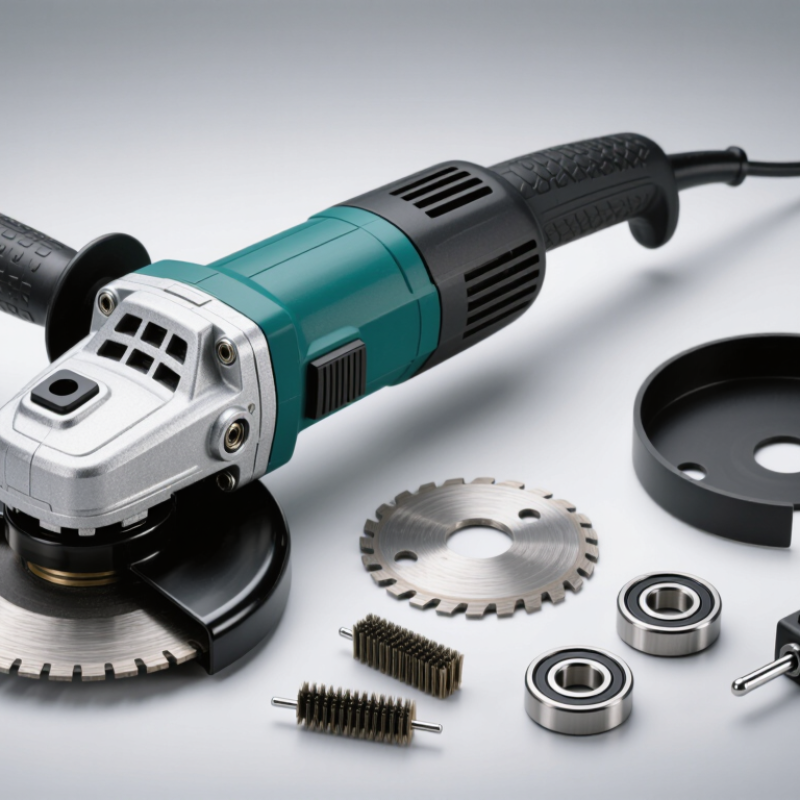
Identify Grinder Type, Power, and IEC 62841-2-3 Compliance
Choosing the right angle grinder parts starts with identifying the grinder type. Check whether it uses a compact, standard, or high-power motor. Confirm the disc diameter, spindle thread, and guard design. A wheel that fits physically may still overload the tool.
Power matters during cutting and grinding. Match replacement switches, carbon brushes, cables, and bearings with the grinder’s voltage and rated input. Higher power can improve performance, but it also creates greater heat and vibration. Inspect the original part carefully. Small differences can affect balance, cooling, or control.
Tips: Read the rating plate and service manual before ordering. Check the spindle size with a caliper, not by guessing. Review the part’s temperature rating and insulation class. For safety-related parts, request traceable test records and installation instructions.
IEC 62841-2-3 compliance deserves careful attention. This standard covers specific safety requirements for hand-held angle grinders, polishers, and sanders. A compatible part should support the tool’s tested safety design, including guarding, switching, insulation, and mechanical strength. Do not assume that an IEC reference alone proves complete compliance. Verify the applicable edition, test documentation, and local requirements. I have found that a perfect physical fit can still be the wrong choice. When uncertain, pause and ask a qualified technician to inspect the assembly.
How to Choose the Right Angle Grinder Parts?
Representative power and no-load speed ranges by grinder type help match discs, guards, flanges, and switches to the tool.
The values shown are typical market ranges represented by midpoint values for common corded angle grinders: 115 mm: 850 W and 11,000 rpm; 125 mm: 1,150 W and 10,000 rpm; 180 mm: 2,150 W and 8,500 rpm; 230 mm: 2,300 W and 6,600 rpm. Actual specifications vary by model. Always confirm disc diameter, rated speed, spindle and flange dimensions, guard compatibility, and electrical ratings before selecting parts. IEC 62841-2-3 compliance must be verified through the product documentation and conformity testing; it cannot be inferred from power or speed alone.
Match Disc Diameter and RPM With ANSI B7.1 Wheel Ratings
How to Choose the Right Angle Grinder Parts?
Disc diameter and RPM must work together. ANSI/ASSP B7.1-2024 requires abrasive wheels to operate within their marked maximum speed. The grinder’s no-load RPM must not exceed the wheel’s rated RPM. A 115 mm disc running at 11,000 RPM reaches about 66 m/s at its rim. A 125 mm disc at the same speed reaches about 72 m/s. That difference creates greater surface speed and heat.
Check both numbers before fitting a disc. The wheel diameter must match the tool guard and spindle design. Never remove the guard to install a larger wheel. ANSI B7.1 also emphasizes proper mounting, inspection, and compatible flanges. A cracked wheel may show only a faint line, not an obvious failure. That is easy to underestimate. The disc rating should meet or exceed the grinder’s stated RPM, not merely look suitable.
The U.S. Bureau of Labor Statistics reported 888,220 private-industry cases involving days away from work in its 2022 Survey of Occupational Injuries and Illnesses. That broad figure does not isolate angle grinders, but it shows why small equipment choices deserve attention. In practice, I have seen users check diameter and forget RPM. I have made that mistake in rushed maintenance work. Read the disc label, inspect the guard, and compare both ratings every time. An extra ten seconds can expose an unsafe match.
Select Compatible Guards, Flanges, Spindles, and Thread Sizes
How to Choose the Right Angle Grinder Parts?
Selecting angle grinder parts starts with compatibility, not appearance. The guard must match the wheel diameter, grinder speed, and cutting or grinding task. OSHA guidance requires guarding against contact with rotating components and flying fragments. The 2023 U.S. Bureau of Labor Statistics report recorded 888,220 nonfatal workplace injuries involving days away from work. That figure covers all industries, but it shows why small fitting errors deserve attention.
Check the flange pair carefully. Both flanges should be flat, clean, and designed for the wheel type. A cutting wheel usually needs a different support arrangement from a depressed-center grinding wheel. Never stack random washers. Do not guess. The spindle must match the grinder’s shaft diameter and locking system. Common thread sizes vary by region and tool class, so verify the manual, spindle marking, and replacement-part specification together. A matching thread is not enough if the shoulder depth is wrong.
Guards should rotate only when the tool is unplugged or disconnected. Test clearance with the wheel installed, but do not force the guard around a thick disc. Industry safety guidance, including ANSI B7.1, emphasizes correct wheel mounting, rated speed, and protective equipment. I still recheck the direction of the flange before tightening; it is an easy detail to overlook. One imperfect assumption can damage the wheel, spindle, or operator’s confidence. Select parts by measured dimensions, rated speed, and documented compatibility—not by a similar photograph.
Choose Carbon Brushes, Bearings, and Switches by Model Number
How to Choose the Right Angle Grinder Parts?
Choose Carbon Brushes, Bearings, and Switches by Model Number
The model number is the safest starting point for selecting angle grinder parts. Do not rely on appearance alone. Two carbon brushes may share the same length but use different holders, springs, or terminals. Check the rating plate, usually near the rear housing. Record every character, including suffixes. A missing letter can indicate a different revision. I once ordered a brush set by size alone. It fitted loosely and produced heavy sparking. That mistake was avoidable.
Match the bearing number, shield type, and internal clearance with the parts diagram. ISO 281:2007 defines bearing rating life at 90% reliability, called L10 life. However, that figure assumes controlled loads and lubrication. Dust, side pressure, and overheating can reduce real service life. Switches also need exact voltage, current, terminal layout, and actuator dimensions. IEC 60745-2-3 addresses safety requirements for handheld grinders, so a visually similar switch is not automatically suitable. A 2024 power tools market report from Fortune Business Insights identifies replacement demand as a major growth factor. More replacements mean more rushed purchases. Slow down.
Before installation, compare the old part with the exploded view. Photograph wire positions. Inspect the commutator for blue discoloration and deep grooves. If a new brush wears unevenly, the armature may be the real problem.
Model matching helps, but it is not perfect. Availability can also tempt users into risky substitutions. When the model number is unreadable, contact the seller with measurements, photos, voltage, and production details.