
FAQS
Top 10 Types of Solar LED Wall Lights for Global Buyers
Solar Led Wall Lights are moving from occasional garden accents to practical tools for safer, lower-energy outdoor spaces. Global buyers now compare brightness, battery capacity, weather resistance, installation time, and long-term reliability. The International Energy Agency reported that global solar photovoltaic capacity exceeded 1,400 GW by the end of 2023. This rapid expansion supports wider consumer familiarity with solar-powered products. However, photovoltaic growth does not automatically prove lighting quality. Product selection still requires careful testing.
The World Bank’s Lighting Global program emphasizes quality assurance for off-grid lighting products, including battery performance, durability, and truthful product claims. These principles also matter when evaluating wall-mounted solar lighting. A 2024 report from the International Energy Agency highlights continued growth in renewable electricity, while energy-efficiency research from the U.S. Department of Energy shows the value of efficient LED technology. Yet, a weakness remains: public reports rarely separate solar wall lights from broader outdoor lighting markets. Buyers should avoid treating every market statistic as product evidence.
This guide examines ten common types, including motion-sensor models, decorative lanterns, security lights, and commercial-grade units. Each type creates a different experience. A narrow beam may illuminate a doorway well, but leave nearby steps dark. A larger battery may improve winter operation, yet increase cost and charging time. Real conditions matter.
Rain, dust, shade, and cold can expose design weaknesses quickly. Independent testing, clear specifications, and credible warranty terms deserve attention. Some claims still sound too optimistic. That is why this comparison focuses on practical performance, not appearance alone.
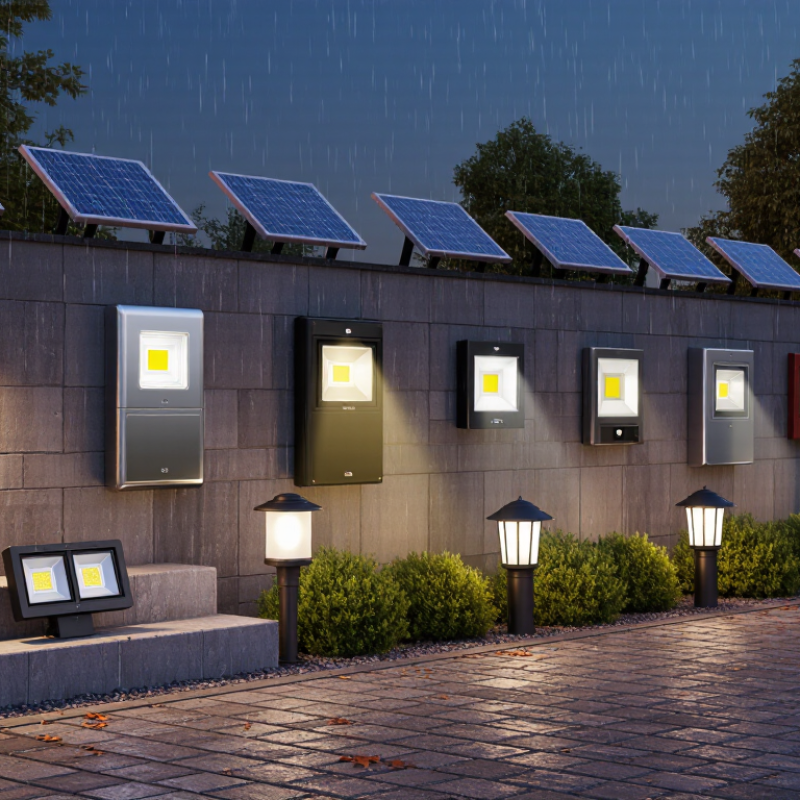
Solar LED Wall Light Basics and Classification Criteria
A solar LED wall light pairs a photovoltaic panel, rechargeable battery, LED source, and control circuit. Classify models by panel arrangement, mounting style, battery access, sensing method, and intended brightness. Some units place the panel above the lamp; others use a separate panel connected by cable. That affects where the light can be installed. A shaded doorway may need a remotely positioned panel.
Global solar growth provides useful context, but it does not predict a light’s performance. IRENA’s Renewable Capacity Statistics 2024 reports 1,419 GW of installed solar capacity worldwide at the end of 2023. For product comparisons, check battery capacity, panel wattage, stated operating hours, and whether those hours assume motion-sensor mode. Review the ingress protection rating and the manufacturer’s test conditions. Ratings alone cannot show how well a fixture handles a north-facing wall or winter shade. Classification is helpful, but not perfect.
Tips: Compare lights under the same conditions. Ask whether runtime figures include dimming or motion sensing. Check that the panel receives several hours of direct sunlight at the actual installation point. A neat specification sheet can still miss that detail.
Ten Major Types of Solar LED Wall Lights Explained
Solar LED wall lights serve different needs, and their construction matters more than appearance alone. Integrated-panel lights place the solar panel above the LEDs, creating a compact option for narrow walls. Split-panel lights use a separate panel, which helps when the wall stays shaded. Motion-sensor lights remain dim until movement occurs. Dusk-to-dawn lights switch on automatically at low brightness. Security flood lights produce a wider, stronger beam for driveways and storage areas. Bright does not always mean better.
Up-and-down lights cast beams in both directions and suit modern façades. Decorative lantern lights add visual character but may sacrifice some output. Adjustable-head lights let users aim illumination toward steps, signs, or entrances. Wall-wash lights spread softer light across textured surfaces. Smart solar wall lights may offer remote controls, timers, or energy reports through wireless connections. During product evaluation, I check battery capacity, charging time, sensor range, beam angle, and waterproof protection. An IP rating supports comparison, but installation quality still affects durability. Cables, seals, and drainage deserve attention. In cold regions, battery performance can fall noticeably. In cloudy climates, a larger panel may be more practical than extra LEDs. One design choice still needs careful reflection: decorative models often look excellent in photographs, yet their small panels may disappoint after several dark nights. Global buyers should match each type with local sunlight, temperature, wall direction, and applicable electrical requirements.
Top 10 Types of Solar LED Wall Lights for Global Buyers — Ten Major Types Explained
| No. | Type | Typical Operation | Indicative Light Output | Common Applications | Key Buying Considerations |
|---|---|---|---|---|---|
| 1 | Motion-Activated Security Wall Light | A motion sensor triggers brighter illumination when movement is detected; some models remain dim or switch off when idle. | Approximately 200–1,000 lumens, depending on design and operating mode | Entrances, garages, side passages, and perimeter walls | Check sensor detection range, detection angle, adjustable settings, and the amount of direct sunlight available for charging. |
| 2 | Dusk-to-Dawn Wall Light | A light sensor switches the lamp on at dusk and off at dawn, usually at a steady or preset brightness. | Approximately 50–300 lumens | Paths, gates, porches, and general outdoor orientation lighting | Confirm the expected nightly runtime and whether the light has a dimming or low-battery mode. |
| 3 | Up-and-Down Wall Washer | Directs light upward and downward along the wall, creating a defined architectural lighting effect. | Approximately 50–300 lumens | Building façades, patios, balconies, and sheltered entrances | Review beam direction, wall clearance, mounting height, and whether the solar panel receives sufficient sun. |
| 4 | Decorative Solar Wall Lantern | Combines a lantern-style housing with ambient LED illumination; operation may be automatic or manually switched. | Approximately 20–200 lumens | Porches, garden walls, courtyards, and entryways | Consider the desired appearance, light diffusion, weather resistance, and whether the decorative housing shades the panel. |
| 5 | Integrated-Panel Solar Wall Sconce | The solar panel, rechargeable battery, LED, and controls are combined in one wall-mounted unit. | Approximately 20–300 lumens | Locations with a sunny wall and straightforward installation needs | Check the panel orientation and ensure the mounting position receives adequate direct sunlight throughout the day. |
| 6 | Split-Panel Solar Wall Light | A separate solar panel connects to the wall-mounted light, allowing the panel and lamp to be positioned independently. | Approximately 100–1,000 lumens | Shaded entrances, covered walls, garages, and locations where the lamp position is not sunny | Check cable length, connector protection, panel mounting options, and the recommended panel placement. |
| 7 | Wall-Mounted Solar Floodlight | Projects a broader, brighter beam; many models combine a motion sensor with selectable lighting modes. | Approximately 300–1,500 lumens | Driveways, larger entrances, loading areas, and outdoor workspaces | Compare beam coverage, mounting flexibility, sensor performance, and runtime at the highest brightness setting. |
| 8 | Solar Step and Porch Light | Provides low-level, localized illumination to help reveal steps, thresholds, and changes in level. | Approximately 5–100 lumens | Stairways, deck edges, porch steps, and narrow walkways | Look for comfortable, low-glare light, secure mounting, and placement that clearly illuminates the walking surface. |
| 9 | Solar Address or House-Number Light | Illuminates a number plate or address panel, often using a dusk-to-dawn sensor. | Approximately 5–100 lumens | House numbers, gates, mail areas, and entrances | Check number visibility from the street, mounting height, panel exposure, and whether the address panel is included. |
| 10 | Adjustable Solar Wall Spotlight | Uses a directional LED head to aim light at a specific area or feature; some designs have an adjustable panel as well. | Approximately 50–500 lumens | Signs, garden features, doorways, and selected façade details | Confirm the adjustment range, beam angle, panel position, and whether the light can be directed without disturbing nearby occupants. |
Note: Light-output ranges are indicative examples, not guaranteed specifications. Actual brightness, runtime, charging performance, and sensor behavior vary by product, battery capacity, solar-panel size, weather, season, and installation location. Check the product specifications and local outdoor electrical and installation requirements before purchasing.
Lighting Performance, Functions, and Ideal Applications
Top 10 Types of Solar LED Wall Lights for Global Buyers
Solar wall lights differ in beam control, battery capacity, and mounting flexibility. The ten common types include compact entryway lights, motion-sensor security lights, dusk-to-dawn models, floodlights, split-panel designs, integrated-panel units, decorative lanterns, up-down wall washers, camera-ready lights, and commercial-grade modular fixtures. Each serves a different application. Entryway and lantern models suit porches, balconies, and garden paths. Floodlights and motion-sensor units provide broader coverage for driveways, warehouses, and perimeter walls. Split-panel designs work well where the wall remains shaded but the solar panel receives direct sunlight.
Performance depends on more than lumen ratings. Check beam angle, color temperature, charging time, battery chemistry, and operating hours during winter. The U.S. Department of Energy reports that LED lighting can use at least 75% less energy than incandescent lighting and last much longer. Solar systems add energy independence, but cloudy regions still require realistic battery sizing. IEA PVPS reported more than 400 GW of new solar capacity globally in 2023, showing stronger solar infrastructure worldwide. However, this does not guarantee equal performance in every climate.
Tips: Select an IP65-rated housing for exposed walls. Test motion sensitivity before permanent installation. Keep panels free from dust and leaves. A wider beam is not always better; it may create glare and reduce useful brightness. Battery claims also deserve review, especially after several cloudy days. Specification sheets can look convincing, yet field testing remains essential.
Installation, Durability, and Maintenance Considerations
For solar LED wall lights, installation quality often matters more than headline lumen claims. Mount the panel where it receives unobstructed sun, while keeping the light aimed at the entrance, path, or loading area. A deep eave can shade the panel even when the wall appears bright. Small details matter. Use corrosion-resistant fasteners near coastal air, seal cable openings, and avoid mounting over spots where water pools.
Check the enclosure rating against the site. Under IEC 60529, IP65 indicates dust-tight protection and resistance to water jets; it does not mean a fixture can be submerged. For exposed walls, inspect seals and cable entries after installation, especially where wind-driven rain is common. NREL’s 2016 photovoltaic degradation review reported a median module degradation rate of about 0.5% per year. That figure describes PV modules broadly, not every compact light panel, so treat it as context rather than a product-life guarantee.
Maintenance is simple, but not zero. Wipe dust, pollen, and bird residue from the panel with a soft cloth; abrasive pads can scratch the surface. Check for loose brackets, cracked seals, and dimming after several cloudy days. Battery performance varies with chemistry, temperature, and charging habits, so buyers should confirm whether the battery is replaceable and how it is accessed. One weak point in many purchasing checklists is overlooking service access. Not always. A sealed unit may look tidy, but replacement can become impractical when the battery eventually fades.
Top 10 Types of Solar LED Wall Lights: Typical Installation Time
Indicative installation times are planning estimates for a typical wall-mounted setup and exclude unusual wiring, masonry, or access work. Actual time varies with the wall material, mounting method, and product design. Solar lights generally require periodic cleaning of the solar panel and inspection of the mounting hardware.
Buying Standards for Global Buyers and Importers
Global buyers should compare solar LED wall lights by measured output, battery capacity, panel size, and operating time—not housing style alone. Ask suppliers for the test conditions behind lumen and runtime claims. A light that runs all night in mild weather may dim early after cloudy days or during winter. Check whether the battery is replaceable, and request its chemistry, rated cycles, and operating-temperature range. Small details matter.
Match each product to its installation site. A shaded entrance needs different panel placement from a sunny garden wall. Review the ingress-protection rating, mounting hardware, cable seals, and corrosion resistance for coastal or wet locations. Request samples and inspect them after several charging cycles; paperwork cannot reveal every fit or finish issue.
Carton dimensions and packing strength also deserve attention, especially when products pass through multiple warehouses. Confirm labeling, manuals, spare-part availability, and inspection criteria before ordering in bulk. Requirements vary by destination, so verify applicable electrical, battery-transport, and product-safety standards with qualified local professionals. One certificate may not cover every market. Even careful specifications can miss real-world shade and user habits.
Skip to content
