

FAQS
What Are the Best Types of Warehouse Heaters in 2026?
Choosing the right warehouse heaters in 2026 requires more than comparing price tags or advertised heat output. Warehouse size, ceiling height, insulation, ventilation, energy costs, and daily operations all influence the best solution. A heater that performs well in a sealed distribution center may struggle in a drafty loading bay.
This guide examines the leading options, including infrared, gas-fired, electric, and heat pump systems. It considers practical issues such as warm-up speed, operating noise, maintenance access, installation demands, and zone control. Real warehouse conditions matter. A cold concrete floor and frequently opened roller door can change comfort levels within minutes.
Safety remains central. Reliable recommendations should reflect manufacturer specifications, professional installation practices, and applicable workplace requirements. Energy efficiency also deserves careful attention, but efficiency figures can look different after harsh winters, poor insulation, or irregular occupancy. That detail is easy to overlook.
There is no universal winner.
A responsible choice balances comfort, operating cost, reliability, and future flexibility. Some facilities may benefit from targeted radiant heat, while others need consistent air temperature across wide storage areas. I will also question common assumptions, because the cheapest installation may create higher maintenance costs later. This comparison aims to help facility managers make a clearer decision, supported by practical evidence rather than exaggerated promises.
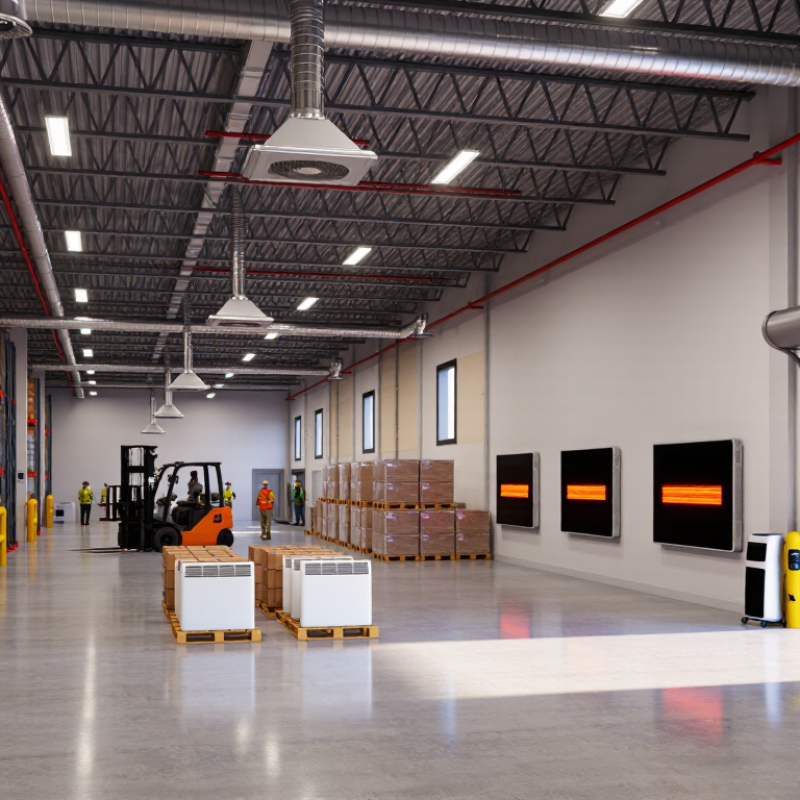
Warehouse Heating Requirements and Selection Criteria for 2026
What Are the Best Types of Warehouse Heaters in 2026?
Warehouse heating requirements begin with the building, not the heater. The International Energy Agency reports that buildings consume about 30% of global energy. Poor insulation, open loading doors, and high ceilings can waste much of that energy. A winter walkthrough matters. Measure cold aisles, door zones, and worker stations separately. Temperature comfort is uneven.
Infrared radiant heaters suit tall warehouses with localized work areas. They warm people and surfaces directly, reducing the need to heat unused upper air. Forced-air heaters respond quickly after doors open, but they may increase drafts and dust movement. Heat pumps can reduce combustion emissions and operating costs, especially in insulated facilities. However, low outdoor temperatures can reduce capacity. This limitation is easy to overlook.
Selection should follow ASHRAE 55 comfort guidance, local safety codes, and the manufacturer’s clearance requirements. The U.S. Department of Energy’s Better Buildings research consistently highlights envelope performance, controls, and air leakage reduction as practical efficiency measures. Use separate zones for docks, storage aisles, and packing areas. Add door controls and sensors where traffic is heavy. Energy monitoring should track fuel or electricity by zone, not only by building. That reveals uncomfortable truths. Sometimes the heater is not the main problem; an open dock door is. Recheck airflow after installation, because a technically efficient system can still create cold workstations.
What Are the Best Types of Warehouse Heaters in 2026? – Warehouse Heating Requirements and Selection Criteria for 2026
| Heating System Type | Typical Capacity or Performance | Typical Operating Efficiency | Best Warehouse Applications | Key Advantages | Main Limitations | Ventilation and Installation Requirements | 2026 Selection Rating |
|---|---|---|---|---|---|---|---|
| Non-Condensing Gas-Fired Unit Heater | Approximately 40,000–400,000 Btu/h per unit; commonly used for medium and large open areas. | Typically 80%–83% AFUE, depending on the equipment and operating conditions. | General-purpose warehouses with natural gas or propane access, moderate insulation, and high ceilings. | High heat output, comparatively low fuel cost in many regions, fast warm-up, and straightforward zoning. | Produces combustion exhaust; heat stratification can occur in high-bay spaces; requires regular maintenance. | Requires approved flue or venting, combustion-air provisions, gas piping, clearances, and compliance with local fuel-gas and fire codes. | |
| Condensing Gas-Fired Unit Heater | Approximately 60,000–400,000 Btu/h per unit, with output selected according to the calculated building heat loss. | Typically 90%–98% AFUE when properly sized and installed. | Large warehouses that operate for long heating seasons or have high fuel consumption. | Higher fuel-use efficiency, reduced exhaust temperature, and strong performance for continuous or extended operation. | Higher initial cost; requires condensate drainage, freeze protection, and careful vent design. | Requires sealed-combustion or approved venting, condensate management, combustion-air planning, and code-compliant installation. | |
| Gas-Fired Radiant Tube Heater | Commonly configured in approximately 50,000–200,000 Btu/h sections or connected tube systems. | Combustion efficiency commonly falls within the approximately 80%–90% range, depending on design and controls. | High-bay warehouses, loading docks, workstations, and buildings with frequently open doors. | Heats people, floors, and surfaces directly; reduces dependence on heating the entire air volume; performs well in drafty zones. | Uneven coverage is possible if layout is poor; combustible-clearance and mounting-height requirements must be observed. | Requires exhaust venting, gas supply, suspension supports, reflector clearance, and careful zoning around storage racks and sprinkler systems. | |
| Electric Resistance Unit Heater | Commonly 5–50 kW per unit; approximately 3,412 Btu/h of heat output per kilowatt. | Nearly 100% conversion of purchased electricity into heat at the point of use. | Small warehouses, low-use areas, electrically constrained zones, and facilities without gas service. | No combustion emissions, simple installation, precise zoning, low maintenance, and quiet operation. | Operating cost can be high where electricity prices are high; large installations may require substantial electrical capacity. | Requires correctly sized circuits, disconnects, overcurrent protection, equipment clearances, and compliance with electrical codes. | |
| Air-Source Heat Pump | Commonly 2–25 tons for packaged or split commercial systems; capacity varies with outdoor temperature. | Seasonal COP commonly about 2.0–4.0; cold-weather output and efficiency decrease as outdoor temperature falls. | Well-insulated warehouses, moderate climates, facilities seeking lower operational emissions, and buildings requiring cooling. | Can provide both heating and cooling; usually delivers more heat per unit of electricity than resistance heating. | Reduced heating capacity in cold weather; may require backup heat, defrost cycles, and adequate outdoor-unit space. | Requires refrigerant-system installation, outdoor airflow clearance, condensate management, electrical capacity, and low-temperature design verification. | |
| Hydronic Unit Heater | Commonly approximately 30,000–400,000 Btu/h per unit, supplied by hot water or glycol solution. | Overall performance depends on the boiler; modern systems may achieve approximately 80%–95% seasonal efficiency. | Facilities that already have a central boiler, process heat, or multiple areas requiring coordinated temperature control. | Durable equipment, quiet operation, flexible zoning, and compatibility with central plant controls. | Requires pumps, piping, freeze protection, boiler capacity, and more complex installation than standalone heaters. | Requires hydronic piping, air removal, expansion control, insulation, water treatment, and protection against freezing. | |
| Destratification Fan with Heating Integration | Fan airflow often ranges from approximately 2,000–20,000 cubic feet per minute per unit; it is normally paired with a heat source. | Does not create heat by itself; can improve delivered heat distribution and reduce ceiling-level temperature differences. | High-bay warehouses where warm air accumulates near the roof and occupied-zone temperatures remain inconsistent. | Improves air mixing, may reduce temperature stratification, and can support lower heating energy use when correctly controlled. | Cannot replace a primary heater; excessive air movement may create drafts or disturb dust and lightweight materials. | Requires suitable mounting, airflow planning, automatic controls, and coordination with smoke-control and sprinkler-system requirements. | |
| Infrared Electric Radiant Heater | Commonly approximately 3–40 kW per panel or heating zone, depending on mounting height and coverage area. | Nearly 100% conversion of electrical input into radiant heat at the point of use. | Focused work areas, loading docks, security stations, and electrically serviced zones that do not require whole-building heating. | Immediate zonal heat, no combustion exhaust, low maintenance, and useful performance in areas with frequent door opening. | Limited whole-building coverage; line-of-sight and mounting height affect comfort; electrical demand can be significant. | Requires electrical circuits, mounting clearances, protection from impact, and layout coordination with racks, lighting, and sprinklers. | |
| Wood-Pellet or Biomass Boiler System | Typically selected for larger facilities with sufficient fuel-storage and material-handling capacity; output varies widely by boiler size. | Often approximately 70%–90% seasonal efficiency, depending on fuel quality, boiler design, and operating control. | Facilities with reliable biomass supply, suitable storage space, and a central hydronic distribution system. | Can reduce dependence on fossil fuels where sustainably sourced fuel is available and may support central heating loads. | Requires fuel delivery, storage, ash handling, operator attention, and more extensive fire-safety planning. | Requires approved combustion equipment, chimney or flue, fuel-storage controls, fire protection, ash disposal, and emissions compliance. |
Selection note: Final equipment sizing should be based on a professional heat-loss calculation that considers outdoor design temperature, insulation, air leakage, ceiling height, door-opening frequency, occupancy, storage-rack layout, ventilation requirements, and local energy and fire codes. Typical efficiency ranges are comparison values; actual performance depends on equipment configuration, controls, maintenance, and operating conditions.
Related Posts
-
Optimal Warehouse Heating Solutions for Enhanced Energy Efficiency in Cold Storage Facilities
-
10 Essential Tips for Choosing the Right Warehouse Heaters?
-
Top 10 Warehouse Heaters Tips to Keep Your Space Warm Efficiently
-

2026 Best Warehouse Heaters for Efficient Industrial Heating Solutions?
-
Best Warehouse Heaters for Efficient Global Sourcing?
-
China Top Industrial Infrared Heater Suppliers?