FAQS
Why Choose a Wall Mounted Patio Heater?
A wall mounted patio heater can turn a chilly corner into a usable outdoor space without claiming to heat the whole garden. Its appeal is practical: mount it above a seating area, aim warmth toward people, and keep floor space free for chairs or a narrow table. Still, placement matters. A heater mounted too high, too far away, or exposed to strong wind may feel disappointing.
The U.S. Department of Energy’s Energy Saver guidance explains that radiant heating warms people and nearby surfaces directly, rather than relying only on heating the surrounding air. That principle helps explain why directional patio heaters can feel comfortable on a cool evening. Grand View Research’s outdoor-heater market coverage tracks demand for these products, but market growth alone does not prove that every model is efficient or right for every patio. Check the manufacturer’s coverage guidance, power requirements, weather rating, and installation instructions before choosing.
The human factor counts. ASHRAE Fellow Robert Bean’s published work on thermal comfort emphasizes that comfort involves more than air temperature; air movement and surrounding surfaces matter, too. I could not verify a published quotation from Bean specifically about wall-mounted patio heaters, so attributing one would be misleading. A wall mounted patio heater may suit a compact balcony or covered terrace, but it is not a cure for poor layout or biting wind. That distinction deserves a closer look.
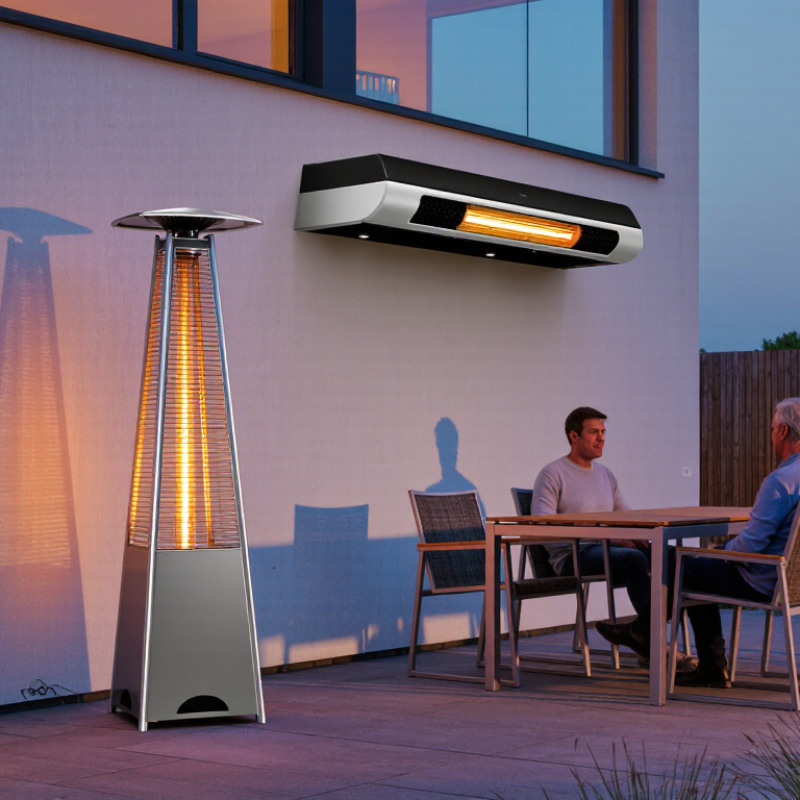
How Wall-Mounted Patio Heaters Work: Radiant Heat Transfers Energy Directly
A wall-mounted patio heater warms people and nearby surfaces through radiant energy, rather than heating all the outdoor air first. Many models use infrared radiation: energy travels outward and is absorbed by your clothing, skin, chairs, and table. The effect is immediate. On a cool evening, you may feel warmth on your hands while the air around your face still feels chilly.
Mounting height and direction affect where that warmth lands. Aim the heater toward the seating area, and check the maker’s instructions for clearances from ceilings, walls, fabrics, and other objects. A heater mounted too high may leave people below its main warming zone; mounted too low, it may crowd the space or create a safety concern. Exact placement depends on the unit and patio layout.
Radiant heat can be useful when a breeze makes conventional air heating less effective, since it warms people and objects directly. Still, coverage is not uniform. Someone sitting beyond the heater’s path may feel noticeably colder, and strong wind can reduce comfort. That limitation is easy to underestimate. Think of the heater as a focused warm patch, not a way to make the whole patio feel like an indoor room.
Choosing Output: A 1.5-kW Heater Uses 1.5 kWh per Hour
A 1.5-kW wall-mounted patio heater uses 1.5 kilowatt-hours of electricity during one hour at full output. The calculation is straightforward. Run it for three full-power hours, and consumption reaches 4.5 kWh. Your cost depends on the electricity rate shown on your bill. At 20 cents per kWh, one full-power hour costs about 30 cents.
That number does not guarantee warmth across an entire patio. Aim the heater toward the chairs or table where people sit. Wind, mounting height, and distance all affect comfort. You may need full output when you first step outside, then less heat later. Or you may not. An exposed patio can lose warmth quickly, even when the heater is running.
Some heaters offer lower settings, which use less power than full output. To estimate your own use, note the setting and run time over several evenings, then multiply consumption by your electricity rate. Keep in mind that this is only an estimate; real conditions vary. A quick calculation can be useful, but I would check it against actual use before relying on it.
Why Choose a Wall-Mounted Patio Heater?
Choosing output: A 1.5-kW heater uses 1.5 kWh of energy for each hour it runs at full power.
Energy use is calculated as rated power (1.5 kW) × operating time. Actual consumption may be lower if the heater cycles or runs at a reduced setting.
Planning Coverage: Compare Manufacturer-Rated Heating Areas
Why Choose a Wall Mounted Patio Heater?
Planning Coverage: Compare Manufacturer-Rated Heating Areas
A wall-mounted patio heater can keep floor space clear and direct warmth toward a seating area. When comparing models, start with each manufacturer’s rated heating area. Treat that figure as a planning estimate, not a guarantee that every corner will feel equally warm. Coverage can depend on mounting height, heater direction, and how exposed the patio is.
Wind changes everything. A table beneath a sheltered roof may feel comfortable, while nearby chairs in an open corner remain chilly. Check whether the stated area assumes indoor-like conditions or an open patio, and compare ratings measured under similar conditions. I find it tempting to focus on the largest number, but that can hide differences in testing and installation. A smaller, well-aimed heating area may suit a compact dining set better.
Sketch the patio and mark the heater’s proposed position, seating, and likely wind path. Then compare that layout with the rated area and the installation guidance. Pay attention to recommended clearances and mounting height; these affect both coverage and safe placement. If the rating does not explain its test conditions, treat it cautiously and ask the supplier for clarification. A little uncertainty is normal. Planning around the actual chairs, not just the patio’s total floor area, usually gives a more useful comparison.
Selecting a Safe Location: Follow Listed Clearance and Mounting Instructions
Why Choose a Wall Mounted Patio Heater?
Selecting a Safe Location: Follow Listed Clearance and Mounting Instructions
A wall mounted patio heater can warm a seating area without taking up floor space. Its fixed position also keeps the unit away from foot traffic. But the wall matters. Before installation, read the heater’s instructions and check every listed clearance. Distances from ceilings, roof overhangs, furniture, and nearby materials can vary by model. Never guess based on another heater you have seen.
Choose a solid mounting surface that can support the unit, and use only the mounting hardware and orientation specified in its instructions. Keep the heater clear of curtains, cushions, branches, and anything that could shift into its path. Check where the power connection will sit, too. A neatly planned location can still be inconvenient if the cord crosses a walkway. Small details are easy to miss.
Tips: Mark the proposed position with painter’s tape, then measure the listed clearances before drilling. Keep the manual nearby during installation. If the wall material or mounting method is unclear, pause and ask a qualified installer. Better to check twice. After mounting, confirm the heater feels secure and that the surrounding area remains clear during normal use.
Weather Protection Explained: IEC 60529 Defines IPX4 Splash Resistance
Why Choose a Wall Mounted Patio Heater?
Weather Protection Explained: IEC 60529 Defines IPX4 Splash Resistance
A wall-mounted patio heater keeps warmth close to seating while leaving floor space clear. Weather protection still matters. IEC 60529, the International Electrotechnical Commission’s enclosure-rating standard, defines IPX4 as protection against splashing water from any direction. The “X” means no dust-protection level is specified. That distinction is easy to miss.
IPX4 is not a promise of protection against water jets, immersion, or every kind of prolonged outdoor exposure. A passing splash test also says nothing about heating performance or safe installation clearances. Check the heater’s instructions and mount it where rain does not pool around the housing or cable entry. An eave helps, but it is not a substitute for following the manufacturer’s guidance. Real patios vary; wind can drive rain sideways.
Tips: Confirm the full IP rating on the product label, not just the sales listing. Keep the unit away from sprinklers, inspect seals and cables regularly, and switch it off before cleaning. If the rating is unclear, ask the supplier before installation.
Related Posts
-
Maximizing Outdoor Comfort: The Ultimate Guide to Choosing Commercial Patio Heaters
-
Why Choose an Infrared Porch Heater for Your Outdoor Space?
-
Top 10 Porch Heaters for Global Buyers in 2026?
-
2026 How to Choose the Best Porch Heaters for Your Home?
-
10 Best Porch Heaters for Outdoor Spaces?
-
Top 10 Best Wall Mounted Patio Heaters for Global Buyers?
Skip to content