FAQS
How to Choose the Best Gazebo Heater?
A gazebo can feel inviting at sunset, then turn chilly when a breeze slips between the posts. A suitable gazebo heater can make outdoor dinners, quiet reading, and weekend gatherings more comfortable. But choosing one is not simply a matter of picking the highest heat rating. The gazebo’s size, open sides, ceiling height, and typical weather all affect how warmth reaches people. A heater that works well beneath a low, sheltered roof may feel weak in a large, exposed space. Small details count.
This guide explains how to compare heater types, heating capacity, fuel or power sources, and practical operating costs. It also considers placement, controls, noise, and the clearances required around furniture, fabric, and overhead structures. Those checks matter. Outdoor heaters vary, and manufacturer instructions should guide installation and use. For example, a tabletop model may suit a compact seating area, while a mounted unit can keep floor space clear. Neither choice is automatically best; comfort depends on the layout and how the gazebo is used. Measurements help, but they cannot predict every cold gust. That uncertainty is worth acknowledging.
By weighing comfort against convenience and safety, you can narrow the options without relying on flashy claims alone. Look for clear product specifications, appropriate certifications, and guidance that matches your installation. A thoughtful choice should warm the people using the gazebo, not merely produce an impressive number on a label.
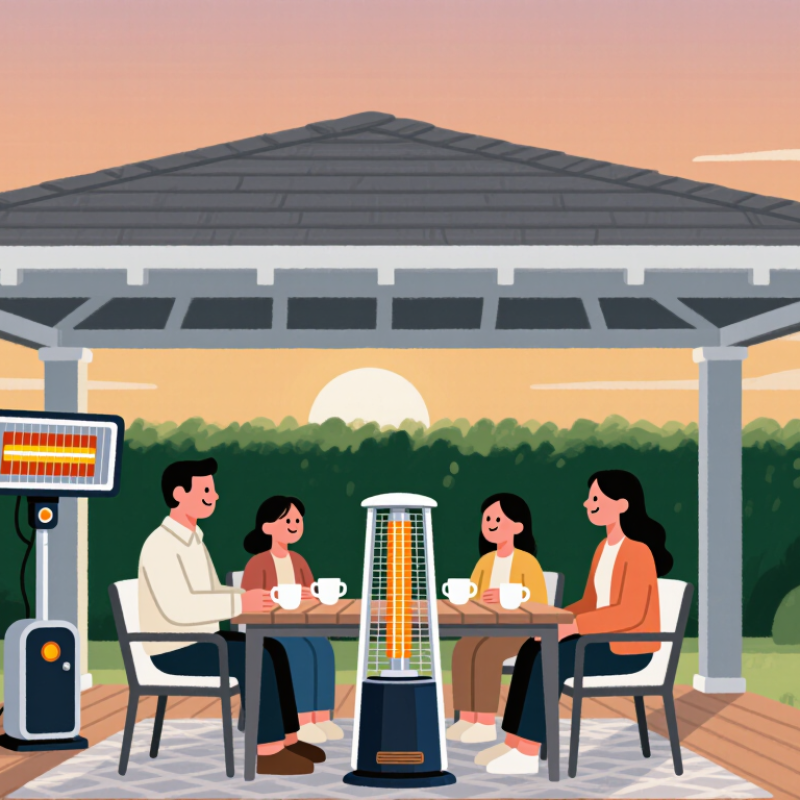
Estimate Gazebo Heat Demand Using 1 W = 3.412 BTU/h
Choosing a gazebo heater starts with the heat you need, not the heater’s appearance. Convert its rated heat output carefully: 1 W equals 3.412 BTU/h. A 1,500 W electric heater delivers about 5,118 BTU/h. Check that the stated rating describes heat output, not just a separate input figure. Small detail. Big difference.
Measure the floor area, then note the ceiling height, open sides, and usual wind exposure. A 10-by-10-foot gazebo has 100 square feet, but area alone cannot predict comfort. Open structures lose warmth quickly, especially when cold air moves beneath the roof. Compare the heater’s coverage guidance with your layout, and allow for greater demand in drafty conditions. This is only a starting point. Your target temperature matters too; taking the edge off a chilly evening differs from aiming for indoor-room comfort.
For a more grounded estimate, use a heat-loss calculation that accounts for outdoor temperature, enclosure, and air leakage. Convert the required watts to BTU/h by multiplying by 3.412, or divide BTU/h by 3.412 to compare watt ratings. The conversion changes units; it does not size the heater by itself. Keep clearances and ventilation unobstructed, following the heater’s instructions. I would recheck the estimate after a cold, breezy evening—my first guess may be wrong.
Compare 1,500-W Electric and 40,000-BTU/h Propane Heater Ratings
How to Choose the Best Gazebo Heater?
A 1,500-watt electric heater delivers about 5,118 Btu per hour. That conversion uses the U.S. Department of Energy’s factor of 3,412 Btu per kilowatt-hour. A 40,000-Btu/h propane rating is nearly eight times higher on paper. A wide gap. But check whether the propane figure describes fuel input or useful heat output; those are not always the same. DOE notes that electric resistance heaters convert nearly all incoming electricity into heat at the point of use, while combustion equipment loses some heat through exhaust.
Fuel use gives the propane rating a practical scale. The U.S. Energy Information Administration reports roughly 91,452 Btu of heat content per gallon of propane. At 40,000 Btu/h, that suggests about 0.44 gallons per hour, before considering operating conditions.
In a gazebo, though, warmth depends on where the heat lands. A radiant electric unit may warm a nearby chair, while a high-output propane heater can cover a broader area—but wind can carry warmth away quickly.
Wind changes everything.
Compare the heater’s stated output, recommended coverage, and operating cost, not just its headline rating. Also check the required clearances and whether the unit is designed for outdoor use. A small electric heater may suit a sheltered seating corner; a larger propane model may be more comfortable in an open space.
I would still test the setup on a cool evening. Ratings cannot predict every draft or cold spot.
Match Heater Type to Gazebo Size, Power Access, and Wind Exposure
Choose by the space you need to warm, not the gazebo’s full floor area. A compact, enclosed gazebo may suit an electric infrared heater aimed at seated guests. Open sides and gusts can quickly disperse warm air. Wind matters. The ASHRAE Handbook—Fundamentals uses local weather conditions, including wind, in heat-loss assessments; your site’s exposure matters more than a neat catalogue estimate.
Check power access before choosing electric. The U.S. Department of Energy’s Energy Saver explains that electric resistance heaters convert essentially all electricity used into heat at the point of use. That does not mean all the warmth stays beneath an open canopy. Check the heater’s wattage against the circuit rating, and avoid relying on a long extension cord. If power is unavailable, a properly rated outdoor gas heater may be more practical, but keep it clear of fabric and follow its safety instructions.
For a windy, open gazebo, prioritize directed radiant warmth and a stable mounting position; for a sheltered space, broader radiant coverage may feel more even. Compare the stated heating area with your seating layout, then leave room for people to move around the heater. A calculator can mislead. I would test the setup on a cool evening, since even a small change in wind direction can shift where the warmth lands.
How to Choose the Best Gazebo Heater? - Match Heater Type to Gazebo Size, Power Access, and Wind Exposure
| Heater Type | Typical Output | Best-Fit Gazebo Size | Power or Fuel Access | Wind Exposure | Best Use and Key Considerations |
|---|---|---|---|---|---|
| Electric infrared wall- or ceiling-mounted | About 1.5–3 kW per unit | Small to medium spaces, roughly 6–15 m² of occupied area per unit; coverage is localized rather than whole-air heating. | Requires a suitably rated electrical circuit. A 1.5 kW unit draws about 12.5 A at 120 V or 6.5 A at 230 V. | Fair to good in light or moderate breezes when aimed at people; direct wind can reduce comfort. | A practical choice when a power supply is available. Fixed mounting keeps the heater out of walkways. Follow the required clearances from fabric, roof panels, and other combustible materials. |
| Portable electric infrared or radiant heater | Commonly about 1.2–1.5 kW | Small gazebos or one seating area, typically about 4–8 m² of localized comfort. | Needs a nearby outlet and a circuit with sufficient spare capacity. Use only an outdoor-rated heater and appropriately protected connections. | Fair in sheltered areas; performance drops when the radiant path is exposed to strong wind. | Easy to reposition, but place it on a stable surface and keep it clear of foot traffic, furniture, and curtains. Do not use an indoor-only portable heater outdoors. |
| Freestanding propane patio heater | Often about 40,000–50,000 BTU/h (approximately 11.7–14.7 kW) | Open, larger gathering areas; warmth is strongest near the heater and does not reliably heat the entire gazebo air volume. | Requires a propane cylinder and adequate outdoor ventilation; no electrical supply is usually needed. | Moderate in calm conditions; exposed locations can disperse warmth and may require a heater specifically designed for the setting. | Use outdoors only, with the clearances and cylinder placement specified in the manual. Never operate under a low or enclosed roof unless the heater is explicitly approved for that installation; combustion appliances can produce carbon monoxide. |
| Natural-gas patio heater | Commonly about 30,000–50,000 BTU/h (approximately 8.8–14.7 kW) | Medium to large, regularly used gazebos where a permanent installation is practical. | Requires a correctly sized gas line and installation by a qualified professional; some models also need electricity for ignition or controls. | Moderate; radiant warmth is more useful than hot-air output in breezy settings, but strong wind still reduces comfort. | Convenient for frequent use without changing cylinders. Verify that the heater and installation are approved for the site, and maintain ventilation and required clearances. |
| Electric fan-forced heater | Typically about 1.5–3 kW | Small, substantially enclosed, draft-controlled spaces; performance is limited in open-sided gazebos. | Requires a suitable electrical circuit. At 120 V, a 1.5 kW heater draws about 12.5 A; higher-output models may require a different circuit or voltage. | Poor in open or windy gazebos because moving air carries heat away. | Consider only where airflow is controlled and the heater is rated for the environment. Check circuit capacity and keep the unit away from fabrics and other combustibles. |
Selection note: Gazebo dimensions alone do not determine comfort. Heater output, open sides, ceiling height, wind, and the distance between the heater and occupants all matter. Coverage figures are indicative comfort zones, not guaranteed room-heating areas. Always follow the heater’s installation instructions, local electrical and fuel codes, and required clearances.
Check Ventilation, Carbon-Monoxide Risk, and Manufacturer Clearance Rules
Before choosing a gazebo heater, check how air moves through the space. A roof and wind screens can trap combustion gases, even when one side looks open. Carbon monoxide has no smell or color. Never rely on your senses to detect it. Use fuel-burning heaters only in conditions the manufacturer explicitly permits, and never operate one in an enclosed or poorly ventilated gazebo.
Fresh air matters. Keep vents and openings clear, and do not block them with curtains, furniture, or storage boxes. A carbon-monoxide alarm can add protection, but it does not make an unsuitable setup safe. If anyone develops a headache, dizziness, nausea, or confusion, move everyone outdoors and seek urgent help. That matters.
Read the heater’s manual before measuring the space. Follow its required clearances from the roof, posts, walls, and anything that can burn. A heater that fits beneath a gazebo roof may still be too close to fabric or a wooden beam. Keep the unit stable on a level surface, away from foot traffic. Electric models avoid combustion gases, but they still need safe spacing and weather protection. I would recheck the manual after moving screens or furniture; small layout changes can alter airflow and clearance.
Verify Outdoor-Rated Certification, Weather Protection, and Operating Costs
A gazebo heater faces more than cold air. Rain can reach the controls, damp fabric can trap moisture, and wind can carry heat away. Check the product’s certification record and confirm that it explicitly permits outdoor use. A general electrical safety mark alone does not prove that an appliance suits an exposed gazebo. Also inspect the manual for clearance distances, mounting limits, and restrictions on use beneath a roof.
Look beyond the word “weatherproof.” The IEC 60529 ingress-protection system classifies resistance to dust and water; an IPX4 rating, for example, indicates protection against splashing water, not every outdoor condition. That distinction matters. I would not trust a polished product label without checking the test scope and installation instructions. Seals, connectors, and switches deserve attention, especially where rain might collect or drip.
Operating costs are easier to compare with a simple calculation. The U.S. Energy Information Administration reported an average residential electricity price of 16.48 cents per kilowatt-hour in 2024. At that rate, a 1,500-watt heater costs about 25 cents per hour, before local price differences. Multiply that estimate by your likely evening runtime, then compare it with the appliance’s rated output and fuel use. Outdoor heat can escape quickly, so a low hourly cost may still buy little comfort on a windy night. I’d factor that uncertainty into the budget.
Related Posts
-
How to Choose the Best Garden Heater for Your Outdoor Space
-
How to Choose the Best Garden Heater for Your Outdoor Space?
-
Why Choose the Best Gazebo Heater for Your Outdoor Comfort?
-
How to Choose the Best Garden Heater for Your Outdoor Space?
-
How to Choose the Best Outdoor Propane Heater for Your Needs
-
How to Choose the Best Natural Gas Patio Heater for Your Needs?
Skip to content